Showing posts with label Grad school. Show all posts

Monday, September 11, 2023

Another dream of my mom

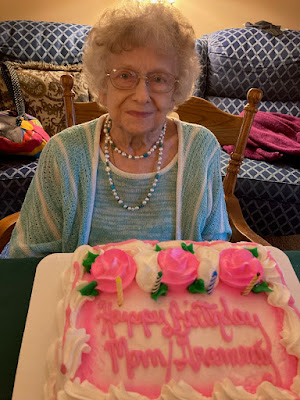
This past Friday would have been my mom's 90th birthday. She had really been looking forward to it. She fell short by six months and a few days.

I had another dream with my mom in it. I wanted to capture if before it fades.

I was in graduate school. Graduate school for me was a truly miserable experience - I have described it as feeling like being mugged while drowning. This version was not much better. I was doing horribly, and so was everyone else around me.

On a whim, inadvisably, I chose to take a weekend off. I spent it with some friends in the Poconos, doing the things we did back then: drinking, hanging out, watching movies, screwing around. Outside of the dream, it was fun remembering those carefree days.

But then it was back to work - or in this case, school. The professor declared that we had all been doing terribly on tests and he wanted to get to the root of the problem. So he gave us another test, but this time he wanted us to write out our reasoning for each answer.

This was graduate school for physics, but the test focused exclusively on advanced mathematics. For every question I was completely stumped: not only did I not see a path to a solution, but I didn't even understand what question was being asked. I scrawled that on the test, noting that I was a physics major, not a mathematics major. I tossed the test aside and felt like a miserable failure.

I heard a ruckus outside. My mother was there, confronting a school administrator. She was young, not much older than I am now, about the age she was when I was in graduate school. She was smartly dressed all in gray, with a gray scarf and gray topcoat. She looked like she had just left work and driven straight to where I was going to grad school - in real life, a nearly three hour drive.

I left the room to speak to her, and she immediately began berating me: Why hadn't I called? Why had I just vanished this past weekend? Why didn't I let her know what was going on?

This made me furious. How dare she embarrass me like this! Why wouldn't she just let me be my own person? I would call her when I damned well felt like it! 

I stormed off back to the classroom, telling her not to call and not to come and visit unannounced. I would call her at some point, maybe.

And that's where the dream ended.


My mom visiting me in Delaware in 1990, after I had dropped out of grad school.
She had come to pick up Josie, a cat who was being given up by her
owners because they had to move and couldn't take her.
She was 56 or 57 in this photo. I'm currently 55.


Thursday, May 17, 2012

Unillustrated Instructional 2: How to boil an egg

OK, first a clarification: this isn't really about how to boil an egg. You'll find plenty of advice on that elsewhere. Someone came up with a clever new way of doing this a while ago - bring the eggs to a boil in a pot, then shut off the heat and leave them, covered, for fifteen minutes - and I found that this resulted in an egg with a mostly-uncooked yolk. That's fine if you're into that sort of thing, I suppose. My advice there: cook the eggs long enough to be hard-boiled, but not so long that you start to remove the water from the egg white, resulting in a tough egg white with a waffle-textured surface.

Also, start by gently heating the water with the eggs already in it. Heating the water too quickly, or adding the eggs to already-boiling water, may make the shells crack.

But enough of that. This instructional is meant to address a more serious issue: distinguishing hard-boiled eggs from uncooked eggs.

When we were kids my mom would mark hard-boiled eggs by drawing smiley faces on them. The problem was, if she did this using a marker, the marker ink would bleed through the shell and get onto the egg white. If she did it with a pencil, the markings would be so light that it would be possible to mistake a hard-boiled egg for a raw one - and sometimes the mistake would go the other way.

A few years ago I remembered something I had heard from the nuns back when I was in grade school, about how in the days of the Great Depression people would dye their Easter Eggs with things like coffee grounds or onion skins. It hit me that adding a piece of onion skin to the pot while boiling eggs might cause some of the color to leak onto the shells. And whaddya know, it worked!

(I recently learned that there's a term for these eggs - pace eggs, though these are associated with the Easter season, and appear to be much more darkly dyed than the eggs I make.)

To boil an egg so that it can be easily distinguished from raw eggs in the refrigerator, add a small bit of onion skin to the pot. That's it. I use roughly a 3/4" x 3/4" bit of onion skin, though whatever size you grab will probably be fine. You're looking for the dry outer skin of the onion, the stuff that ends up left over in the bag. The larger the piece the darker the color of the boiled eggs. A small piece will cause them to turn beige, a moderate piece will give a buff color like those fancy expensive eggs at the supermarket (so this is an inexpensive way to fool any snoopy friends who might judge you by the color of your eggs), and a lot of skin will turn the eggs a mottled brown.

One note: this doesn't seem to work with the purple outer skins of red onions. If you're feeling adventurous and want to experiment with marking your eggs red, you might want to add some beet juice to the water when you boil the eggs. This might (or might not) change the taste of the eggs - I have no idea.

Wednesday, May 16, 2012

Unillustrated Instructional 1: How to use a notebook

For years I've wanted to share some of the hard-learned lessons in my life with my blog readers. I figured I would write up a series of simple instructional posts to cover hints, tips, and solutions to everyday annoyances. Why, I could even illustrate them with photos! All I had to do was get around to taking the photos.


And so I waited...and waited...and waited...


...and finally I thought, Fine, I'll go without the photos!


Which brings us to here.

My first instructional is on something most of us have probably been doing, off and on, since first grade: How to use a notebook. I've spent the last few weeks in a training course for a new job (yes, amazingly enough, some employers are still willing to train new employees for their jobs - and pay them during the training, too!) and have filled several notebooks with notes. That's a lot of notes, covering a lot of subjects, taken over a lot of days. By observing how other people have been taking notes. I've developed some new notebook management skills that have been very useful.

1. Put the date on every page. In grade school I got into the habit of putting the date at the beginning of each day's notes. This made it easy to flip back and see what information was covered on which day, and to review information from a specific day. But after observing a fellow trainee putting the date on the upper outside top line of each page, I realized how much easier it would be to locate a specific day's notes, or to tell which day each page of notes was from, if the date was included on every page.

2. Use the top margin space on every page for broad subject headers. As in a textbook, this makes it easy to flip through the notebook and find which topic was being covered on each day.

3. Use the outer margin areas on every page for specific topic guides. This is the left-hand margin on the left pages, and the right-hand margin on the right pages. You could also use this space for the broad subject headers, but that might be redundant. Instead, focus on what's specifically being covered on that page. Write this information however it works for you. I find it most effective to write it so it can be read when the book is held sideways. I write the words so they are all properly aligned, regardless of what page they are on, when the notebook is held sideways with the spine at the top.

4. Leave plenty of room for future notes. I used to like to fill in notebooks very neatly, or cram them full of information. But you should allow for the possibility that you will be adding notes to your notes somewhere down the line. Maybe this will be an expansion of the notes you have taken, maybe a clarification, or maybe just notes about the notes. Whatever the reason, you may find yourself adding notes to your notes.

And that's that. Whether you're filling a notebook with information for a class, or are just writing poems and stories for your own amusement, following these steps may help make your notebook more useful to you.

Do you have any hints and tips on using a notebook? Let me know in the comments, and maybe I'll add them to this post!

Tuesday, January 05, 2010

Tapestry

Note: Some of these blog posts have been composed long before they are written. This is one of them. It - well, the thinking that went into it - dates from before the events of Tuesday, August 12, 2009. If I were to be initiating these thoughts now, I might have a different answer. But...well, see the Afterword.

If you knew then what you know now, what would you do differently?

In other words, if you could change some action, some decision, some direction in your life, what would it be?

For the longest time, my answer to this has been the same: Nothing. Each action, each decision, each direction chosen was done, made, or taken for very good reasons - or what I believed at the time were very good reasons. Have I done stupid, regrettable things? Sure. Am I happy with where my life has taken me? Not entirely. Is this the best I could have done? Probably not.

One of my favorite episodes of Star Trek: The Next Generation is the sixth season episode called "Tapestry." It's A Q episode, which probably should have disqualified it from consideration - having a mischievous deus ex machina hanging around in the series, beginning with the first episode and ending with the (excellent) final episode, was just annoying to me, and a potentially fatal flaw. (What is the point of anything if this guy could pop in at any time and change everything?) And while the presence of Q is necessary to the story of "Tapestry," it also undermines the theme of actions having consequences.

But I'm getting ahead of myself.

In the episode, Captain Picard receives a fatal wound - more precisely, fatal damage to his artificial heart, a prosthetic necessitated by the fact that his original heart was damaged in a bar brawl when Picard was a young Starfleet officer. (Or cadet. Whatever.) The bar brawl was actually a fight with three Nausicaans, large, belligerent aliens who...well, let's just say they had it coming. Picard fought them, got stabbed in the back, his heart was destroyed, he got an artificial one. Decades later, his artificial heart was fatally damaged by an energy discharge.

Picard is given the opportunity to change the past - to avoid the event that led to him needing the artificial heart. (The energy discharge that damaged his artificial heart would not have been lethal to a flesh-and-blood organ.) He takes this path, and then gets to witness his life unmade: that single change leads to a series of different actions, different choices, different directions. Returned to his present time, he is now a subordinate officer who plays a menial role in the functioning of the ship he had once captained, running reports to his superiors. One thread of his life has been pulled, and the tapestry of his life has unwoven.

In the end, he gets a chance to put it all back the way it was before, with a knife through his heart in the past, and a damaged artificial heart in the present - and finds that the surgeons operating on him after the energy discharge were able to save his life. The series continues, with Picard as captain of the Enterprise.

A few months ago (well, eleven months and four days ago, to be exact) a blogfriend was having a crisis of faith, wondering if perhaps academia was not the right path for her, if maybe she should just stop being a scientist at a major research university. More specifically, she was starting to feel a case of Impostor Syndrome. I left a comment for her:

Ooooh. Impostor syndrome. Fight it. That's like doubt to a Mentat. Let it get a hold and next thing you'll know is that you've been working in a factory for seventeen years, and it will suddenly occur to you to wonder why you didn't re-apply to your first choice of grad schools (which wasn't accepting ANY grad students the year you graduated from college) after you washed out of your soulless second choice after one semester.
And as I left that comment, I realized that there was something I might have changed in the past.

I've told this story before - I think. Brief overview: I was in my final year as an undergrad at the University of Scranton, double-majoring in Physics and Philosophy. I had applied and been accepted to several graduate programs, including Bryn Mawr and the University of Delaware. Both of these schools had programs in Non-Linear Dynamics, which was the field I wanted to specialize in. Bryn Mawr was a better fit, much more closely resembling the University of Scranton: small Liberal Arts University with a small Physics program and a fantastic student/teacher ratio. The University of Delaware was a much larger state University with a much larger Physics program and only a single professor specializing in my chosen area.

But Bryn Mawr suddenly stopped taking graduate students for the Fall 1989 semester - after I had been accepted. I knew this before the head of the Physics department did. He only received official confirmation minutes before I was supposed to head down for my first face-to-face meeting.

Suddenly I was heading to my second choice school, the University of Delaware.

Delaware ate me up and spit me out. The experience, as I have said before, was like being mugged while drowning. I felt incompetent in every way possible. I washed out after a single semester.

There's no guarantee this wouldn't have happened at Bryn Mawr, of course.

And what did I do afterwards? Did I jump right on the Internet, check out the current status of the Bryn Mawr grad program, maybe see if they were accepting students for the Spring semester? Drop an e-mail to the head of the department to see if I could get on a waiting list, or an announcement list for when the program was back on track? Try to bounce right back, get on the horse, take this as a blessing in disguise?

No. None of that. Partly because the Internet, and email, and computers as we know them didn't exist back in early 1990, not in a form any of us would find useful. Contact Bryn Mawr? I'd have to go hunting for an address or a phone number, maybe do some digging in the library. Maybe type out a letter on my electric typewriter - on carbon paper, so I could have a copy.

Partly because I had decided, stoically, stupidly, to play the hand I had been dealt. I had no car - back then, Newark, Delaware was a pretty bike-friendly area. I was less than halfway through a one-year lease. There were employers in the area. I decided to find a job (now that I had lost my teaching assistanceship) and try to earn at least enough money to pay the rent and my living expenses for a while.

And partly because, until I wrote that comment, it had never occurred to me that that was exactly what I should have done.

Would it have worked out? Would I have continued along on my life plan, gotten my Ph.D. by age 27? Would I now be writing popular science books for laymen?

I have no idea.

I stayed in Delaware for another year, working at the solar cell manufacturer to which a kindly University of Delaware Physics professor had pointed me. At the end of that year I went back to Rockville - well, Nanticoke.

A few months after I came home my 81-year-old grandmother was felled by a severe, crippling case of sciatica. She needed a round-the-clock nurse to watch over her.

I took that position.

Several months later she was well enough to return to her home. By then I had found a job at a CD manufacturer. The rest, as they say, is history.

So if I had bounced back after Delaware and somehow gotten right into some hypothetically rebooted program at Bryn Mawr in the Spring or Fall of 1990, how would my life after that point have been different?

Well, in most major respects that's unanswerable. There are too many points of divergence to make any statement. But one thing is for sure: I would not have been there when my grandmother needed me. Her life, and my life with respect to her, might have played out completely differently. Would she have spent the rest of her days in a nursing home, rather than first entering one in early 1996? Would she have had a stroke in - when was it, 1992, 1993? Would she have lived beyond 1998, or maybe died before then?

I don't know. Our lives are a tapestry of actions we have taken, decisions we have made, directions we have gone, people we have known, places we have been. Pluck one thread and the whole fabric begins to unravel.


Afterword:

A few weeks ago, I took my mom for an outpatient procedure - the same procedure for which I had taken her the day I believe I accidentally killed the kitten Gretchen by crushing her under an electric-powered recliner/lift chair. The day that we discovered her decomposing body under the chair, I wanted to cut the plug off to stop it from ever being used again. But my mom stopped me, because she knows there may soon come a day when someone actually needs such a chair. But from that day the chair has been unplugged, and I have allowed no one to use it.

Until the day of this recent procedure, when my mom insisted she needed to sit and put up her legs. I assented, but only on the condition that I check under the chair before she put down the leg lift, the mechanism that I think broke Gretchen's neck.

In her post-procedure stupor she didn't entirely adhere to the plan. When my mother tired of sitting in the chair she decided to get out out of it without putting the leg lift down. This required some acrobatics on her part, and could have undone the effects of the procedure she had just undergone. But once out of the chair, she looked under it to see if it was safe to put down the leg lift.

And there was Amber, curled up almost exactly where Gretchen had been. If my mom had lowered the leg lift, Amber might have died as silently and horribly as Gretchen.

So because Gretchen died, Amber lived.

The chair is once again unplugged and off-limits.

Thursday, November 19, 2009

The beauty of mathematics

Once upon a time I was a Physics graduate student. It didn't last long, only a single semester. I was in the wrong place; the place where I wanted to be, where I should have been, had stopped taking any graduate students that year - shortly after I had been accepted into their graduate program. I was in the wrong time; if it had been twenty years later, or even ten years later, and the Internet had been in something more than the embryonic state it was in in 1990, I might have bounced back and straight into another graduate program. But that's a story for another time.

My chosen field of study was Non-Linear Dynamics. Chaos. The physics of complex systems. Very cool stuff. Not many places were specializing in that back then. My first-choice school was. My second-choice school had a single professor who was, which is why they were my second choice. I never really got to develop much of a relationship with him. As I have said before, my entire experience was something like getting mugged while drowning. Not very good.

Phil Plait over at Bad Astronomy has done a post that reminded me of the beauty that underlies non-linear dynamics. If you're a fan of complex math, or if you like seeing beautiful things, check out his post and follow the links. It's reminding me of who I once was, and what I once loved. Go and see why.

Thursday, July 16, 2009

Twenty years ago twenty years ago

I remember what I was doing twenty years ago. The year was 1989, and I was getting ready to visit the University of Delaware for the first time.

Delaware wasn't my first choice for grad school. That was Bryn Mawr, a small Liberal Arts university with a small Physics program focused specifically on Non-Linear Dynamics, the field of study I wanted to specialize in. But Bryn Mawr's graduate program collapsed that year, as I found out just days before I was to visit that campus. So I had to go with my second choice.

The plan of the visit was pretty simple: go down, get the lay of the land, meet some of my professors, arrange to rent an apartment. Not too much preparation involved, but I remember being nervous before I went down. And I remember what was on television then: special programming commemorating the first landing on the Moon, twenty years earlier.

Twenty years! It seemed like forever. I was only twenty-one at the time, so twenty years was most of my life. How shameful, that after all that effort, all those risks, all those sacrifices, so many years had passed since humanity last set foot on the Moon. How many more years would pass before we went back?

The answer is: a lot.

Twenty more years have passed since then, and now we are looking back on events that took place forty years ago. I can tell you that the last twenty years have passed like a shot, despite being packed with events that would take nearly that long to recount. But forty years - I mean, I've only been alive for forty-one years, so that's practically my entire life. Forty years is, like, forever!

So how many more years will pass before we go back?

Website recommendation: Wechoosethemoon.org, replaying the events of forty years ago in real time!

Saturday, March 07, 2009

Let me tell you what I've done. (part 1)

A few months ago this was going around the blogosphere as an honest-to-goodness meme: people were spontaneously writing out their work histories, like resumés in essay form. Nobody seemed to be saying "I saw so-and-so do this, so I thought I would, too." The odd thing was, I had been planning to do the same thing myself for some time.

Yesterday I had an opportunity to review my resumé and I found myself thinking, "Dammit, I've had some great jobs." It was depressing, really. But maybe I should take hope knowing where I've been.

So here it is. It turned out to be so long that I've had to break it up into multiple parts.


I didn't have very many jobs in High School. I really wasn't working towards buying a car or having beer money, so I tended to focus on my schoolwork all through the school year and play all Summer long. My only significant job was in the Summer after my (I think) Junior* Sophomore year and consisted of dogsitting for a neighbor family while they were away on a multi-week vacation. They kept the dog cooped up in a small room in their basement, lined with papers, and they wanted me to let the dog out and clean the papers twice a day. But Skippy was a young, energetic dog, and it seemed cruel to keep him cooped up in a stuffy room for so long. So I visited him multiple times each day, and took him out for extended romps. He and I developed a bond that Summer. They moved away later that year, and I heard that Skippy was hit by a car and killed soon after.

The only other jobs I had in High School were actually after graduation and before the start of college. One was an inventory job at a store at the Wyoming Valley Mall. It was me and about two dozen other temporary employees, hired specifically for a big inventory count. Each of us was assigned to an area, and we were paid something around minimum wage for our efforts. I completed my count quickly, efficiently, and accurately, turned in my numbers, and was paid for the time I had worked. Other people who were working more slowly and less efficiently were still on the job, earning money, when I was sent on my way. I learned a lesson about doing a timely and efficient job that day.

I searched the mall for other job opportunities and found one as a stock boy at a women's clothing store. That was interesting, for the few weeks that it lasted.

In college my main job was maintaining my GPA to maintain the merit-based scholarships that were paying for my education. Without them I would not have been able to attend college, or would have had to go into debt so deeply that I might still be trying to pay off my loans.

Between semesters I worked at Owens-Illinois, later OI-NEG, later Techneglas. This was a glass factory that manufactured TV faceplates. (The NEG stood for "Nippon Electric Glass", a Japanese manufacturer that bought, and eventually closed, the factory.) For three summers I worked there, handling heavy faceplates for eight hours at a time. My fingers are still curled from the carpal tunnel I developed there, and I have learned to ignore the hisssss of tinnitus that came from being exposed to the industrial sounds all day.

During my time in grad school I was a "teaching assistant" in Introduction to Physics labs at the University of Delaware. What this meant was that I was the teacher for the lab, responsible for introducing upwards of eighty non-science students to the wonders of Physics in action, and designing, administering, and grading exams. This lasted as long as my graduate career, one semester.

After I left grad school I made the decision to stick it out in Delaware for at least the rest of the term of my lease and find employment somewhere in the area. Newark, Delaware is an area full of industry of all sorts, so this didn't seem like such an unlikely proposition. With the guidance of one of my former graduate professors I was able to get a job at a solar cell manufacturer called AstroPower. I started off assisting in the testing and evaluation of incoming silicon substrates that would be turned into solar cells. I took to the work, and was fascinated by the place, and at the end of the first year of my lease I signed on for a second. Changes came to the place, including my first experience with a Reduction In Force, or RIF; I survived it, but my supervisor did not. I assumed his job while maintaining my current pay, which was barely above minimum wage. As the second year of my lease began to draw to a close I observed that I had taken on more and more responsibilities, including the management of several employees, but was barely making enough money to pay the rent. With some regret, I informed my manager that I would be leaving when August rolled around. And I did, with a heavy heart.

I came back to Nanticoke feeling like a failure. I began a half-hearted job search, but shortly thereafter my grandmother was felled by sciatica. She needed around-the clock assistance just to get around the house - my mom's house, since it was the only house of a local family member where my grandmother would be able to get around without needing to climb stairs. Getting a nurse to watch over her would be prohibitively expensive. Since I wasn't doing anything else at that moment, I was the obvious choice to be her caretaker.

She gradually regained her strength and mobility. I took her out on the occasional outings, including shopping trips. By the Spring of 1992 she was able to live on her own again. Which was fortunate, because shortly after that I received a call that there was a job available for me at a place I had been trying repeatedly to get into - Specialty Records, a local record, tape, and CD manufacturer.


To be continued. Part 2 will cover the various jobs I have held at Specialty Records and its successor companies.

*The Summer after my Junior year I was at Pennsylvania Governor's School for the Sciences.

Monday, September 01, 2008

Unpacking your life

I went over to my house late yesterday afternoon and assembled another bookcase. By the time I was done it was dark, and I decided to turn in for the night and get a fresh start in the morning.

This morning I popped open a few more footlockers full of books and emptied them onto the shelves I had built the previous evening, arranging them by vertical size more than any other consideration. Then it was time to assemble another bookcase, in this case the black three-shelf model from Target.* After that was done, it was time to open more footlockers. What about these, over here...?

Ka-boom.

I opened a footlocker full of Physics textbooks. Books from my college days. Books from my brief, miserable stint in grad school. Books that I bought just to study on my own. Thermodynamics and Mathematical Physics and Electromagnetics and Linear Algebra and Superstrings and lots of books on Non-Linear Dynamics.

Here it was: everything I had once been, everything I had once planned to become, all neatly consolidated on several thousand sheets of paper.

I handled the books reverently. I could still do this, I thought. Fat chance. Maybe.

I lined them up: Mathematical Physics and Calculus and Linear Algebra and Solutions to Partial Differential Equations along the bottom. Superstrings and Electromagnetics and General Physics and two different copies of the Feynman Lectures in Physics on the middle shelf. Thermodynamics and Non-Linear Dynamics - the topic I had intended to study in grad school - on the top.

I came across a book called The Einstein Scrapbook in the same footlocker, a gift from some friends years ago. Einstein has never been a huge hero of mine - he's too inaccessible, too out there. Richard P. Feynman has aways been more my sort of hero. But as I flipped through the Einstein book I looked at some of the photos. One of them was of cards made for him by children on the occasion of his fiftieth birthday. Ten years older than me.

If everything had gone according to plan, I would have had my Ph.D. by 1995, been a working Physicist sometime after (or, more likely, before) that, and would have put out three or four books of science popularizations for non-science audiences by now.

Things didn't go according to plan.

I loaded up the shelves with the textbooks, then put some of the popular science books in one of the bookcases I had previously assembled, after first shuffling some of the books to make room and consigning others to the "children's table" of paperback bookshelves. Up went "Surely You're Joking, Mr. Feynman!" and "What Do You Care What Other People Think?" and two copies of Tuva or Bust. Not everything in my Richard Feynman collection - I still have to locate Genius and No Ordinary Genius and The Pleasure of Finding Things Out and Perfectly Reasonable Deviations from the Beaten Track, and possibly a few others.

I leafed through a few more books. Flipped through the two volumes of the 9-11 tribute put together by comics artists and writers. Seventh anniversary is coming up soon. Seven years...

I was tired. I had accomplished what I had set out to do this weekend.

I closed up the house and left.


Video time: Once again, Buffalo Tom fits my melancholy mood. I've known of this song for years, mainly thanks to the Kevin Smith* movie (which I've never seen) that took its name from the song, but I never heard it before last Sunday. There's something incredibly beautiful about this song. Give it a listen.

Taillights Fade, Buffalo Tom:


*The bookcase from Target seems to be made from higher-quality materials than the ones I got from Wal-Mart, though both of them are quite cheaply made. Target's all-plastic fastners actually seem inferior to the ones included with the Wal-Mart shelves, and assembly was more difficult for the one from Target. But if I buy another bookcase - and will need to - I will try to get one or two tall black bookcases from Target, and then go to a hardware store to try to replace some or all of the included fasteners with higher-quality items, at least wooden or metal dowels to replace the fragile plastic dowels that are supposed to support the shelves.

I definitely like the black finish more than the fake oak finish. I thought it would make the room look smaller, but instead it makes the book spines pop out into high visibility.

**This is not a Kevin Smith movie. Why did I think it was? The only real connection is actor Jason Mewes, as far as I can tell - "Jay" of Jay and Silent Bob fame.

Sunday, January 07, 2007

Waiting

A chance encounter with a very friendly waitress on New Year's Eve got me thinking about two other women I have gotten to know through their positions as waitresses.

It was back in 1990, in Newark, Delaware, after I had dropped out of grad school at the University of Delaware and started working for a solar cell manufacturer. One of my friends from the grad program was seeing a woman named Genie. We all continued to hang out together even after I was no longer going to school. That summer she picked up a job at a new coffee shop, the Café Americain. (It was attached to a video store and was trying to play on the name of Rick's place from Casablanca.)

The coffee shop was OK. I never spent much time in the video store - I didn't have a VCR, and DVD players were still years in the future. (Seven years, to be exact, and now they've been around for ten. Weird.) Possibly the first time I ever went in there was when I was trying to get in touch with Genie. I don't remember what it was for, I just remember riding my bike up to the place, chaining it to the steps outside, and going in looking for Genie. She wasn't there, but a pretty dark-haired bright-eyed girl was. I asked about Genie, she told me she wouldn't be in until later, and I asked if she could pass along my message. She told me yes, gave me a little smile, and the espresso machine she was filling exploded.

Well, it didn't really explode. But something happened, and the high-pressure water that is forced through the coffee grounds in an espresso machine did so while the basket was still partly opened. Damp coffee grounds shot everywhere as I was headed for the door.

I offered to stay and help clean up the mess, since I felt somehow responsible, but she shooed me away with a laugh.

I would be back.

Her name was Jessica Wolvek. She was a student at the University and worked most afternoons at the Café. I would stop in on my way home from work to get a hazelnut coffee and a cherry cheese croissant. Sometimes there were other people in the Café. Sometimes it was just me. Those times, she and I would spend a long time just talking. About...stuff. Coffee. Croissants. Relationships. Her nickname and how she got it. Life. The Universe. Everything.

Some days she wasn't there. Some of the time there was a pretty, thin, young, quiet redhead there instead. Very young - still in High School. Her name was Rejoyce Soukup. She and Jessica were friends, I think, at least through work. I would talk to her sometimes, though our conversations were not as far-reaching as with Jessica. I did learn from her, however, that the infrared signature of eggplant plants matches the infrared signature of marijuana plants, at least as far as DEA helicopters could tell in the early '90's. So that was interesting.

In time things started to change and go away. One day the Café stopped carrying the cherry cheese croissants. Then they stopped serving hazelnut coffee. After a while Jessica and Rejoyce were no longer working there, and I no longer had any reason at all to go there. Eventually the Café went out of business. Nothing ever stays the same.

Early in the morning of the first day of 2007 I found myself online and completely wound up. My mind was mulling over auld acquaintances that should not be forgot and ne'er brought to mind. I thought about Jessica and Rejoyce. Where are they now, and what are they up to?

Jessica I have looked up in the past, around the time that I discovered traces of Rindi online. Looking her up again produced fewer hits, but one was recent and quite definitely her. Jessica is now a professional flower arranger in New York City. That sounds pretty amazing. Good luck with it, kiddo. If you need flowers arranged and you live in The Big Apple, get in touch with her. Tell her I sent you!

Rejoyce should have been at least as easy to find, but her name doesn't appear anywhere I could find it as a single unit. I found her first and last names mentioned individually on a blog by a guy in the Peace Corps in Kyrgyzstan. I wasn't sure it was her until I saw a reference to Newark, Delaware and some good close-up photos. It's been almost 17 years, and I do have a touch of prospagnosia prosopagnosia, but I'm pretty sure that's her in the pictures. So the answer to "Where is she now?" is, for the moment, "Kyrgyzstan"!

It was gratifying to see that these two women who I knew so long ago are still both around and about and are both doing things that they love. Good luck to them both!

Wednesday, December 20, 2006

Carl Sagan

Carl Sagan is always on my mind this time of year. I've been planning on writing a piece about him for some time. As it turns out, today is the tenth anniversary of his death. Phil Plait at Bad Astronomy has called his readers' attention to Joel Schlosberg's plan to have a Carl Sagan Memorial Blog-A-Thon to commemorate his life and influence. So what better time to write this post than now?

Carl Sagan's Cosmos came onto the scene when I was twelve years old, at the same time as a great many other influential events in my life. Star Wars had exploded onto movie screens just a few years before. The Viking missions had shown us Mars, and the Voyager missions were sending back amazing images of Jupiter and Saturn and their many moons. The Space Shuttle had been tested and was being readied for flight. Jupiter and Saturn were engaging in a long, complicated series of maneuvers in the evening sky. The Hitchhiker's Guide to The Galaxy was hitting the airwaves in America for the first time. I had discovered Dungeons & Dragons (with the polyhedral dice so well explained in the back of the Cosmos book) and begun reading Tolkien and Niven and Ellison and OMNI magazine.

And there was Carl Sagan on the cover of TIME magazine, standing on the shore of the cosmic ocean. There was Carl Sagan on television every Sunday night, showing us the beauty and wonder of the cosmos and saying "Look at this! Isn't it amazing?" To us. To me. He didn't just bring the beauty and wonder of the cosmos to the general public. He brought it to me, and that was infinitely more valuable - in my mind, anyway.

(A side note: Carl Sagan appeared on the cover of TIME magazine on October 20, 1980. But I associate Sagan with Advent, the four weeks before Christmas, the lighting of the Advent Wreath in the upstairs hallway of my school, a chorus of children's voices singing "O Come, O Come, Emmanuel". Why? Because my grandmother was my one source for TIME magazines, and she would get them from my uncle in Maryland, who had a subscription. He would gather up his old magazines and bring them up to my grandmother when he would visit throughout the year. He would have brought the October 20, 1980 issue to her when he came in to visit at Thanksgiving. So I would not have seen this issue until after the start of Advent.)

I graduated from Catholic grade school in 1981 and survived four years of High School. When I started college in 1985 I double-majored in Physics and Philosophy - perhaps more influenced by a certain pointy-eared Vulcan than by Carl Sagan and Cosmos. But as I neared the end of college I began to formulate a plan: I would become the next Carl Sagan.

No, I would not become brilliant or influential or directly involved in planetary exploration. But when I entered graduate school at age 21 my goal was to have a Ph.D. by age 27 and to have published my first book by age 30. Carl Sagan had brought the wonder of the Cosmos to the people. I would carry on what he had started. I would use my unique blend of knowledge, experience, and skills to write books on advanced topics in science that would appeal to and be comprehendible by the common layman.

It didn't work out that way. Graduate school was the single most horrible and humiliating event in my life. I have compared it to being mugged while drowning. Maybe at another school, in another program, things might have been different. Maybe not. Maybe I just wasn't up to the challenge.

Besides, there already was a Carl Sagan.

He's gone now. Dead these past ten years. This blog is the closest I've come to my dream of being a writer who would share his love of the universe with the rest of the world. But Carl Sagan's work lives on. He touched and influenced many, many lives. Maybe no one of us will ever be the next Carl Sagan, but maybe, just maybe, each of us can carry a small spark of the flame that he touched us with. And somewhere along the line, we can share that spark with others.

Wednesday, June 07, 2006

Incompetence

Two things make me feel absolutely incompetent: graduate school and home improvement stores.

My graduate school career was nasty, brutish, and short* and made it quite emphatically clear that I am not cut out for specializing in one particular field of knowledge while ignoring all other aspects of the human experience.** There are few feelings like walking into a situation feeling some trepidation but having a general sense of optimism that with enough hard work and determination you will be able to succeed, and walking out a few months later feeling like the biggest idiot in the world.

Home improvement stores are another matter. I think some latent form of spatial dyslexia kicks in as I walk among rack upon rack of almost-but-not-quite identical items. Everything looks the same to me and my planned purchases become ordeals. Do I want this ladder, or this ladder, or one of those ladders? These are drill bits, these are screwdrivers, where are the nail sets? Are there any safety glasses here that don't make me look like a Bono wannabe?

I spent nearly twenty minutes after work today walking up and down aisles of cleaning supplies, paints, and mailboxes (with a side trip to the storm door department to discover that, alas, the storm door I have in mind does not come in red) before I stopped a clerk on a ladder who was stocking shelves in the cleaning supplies area and asked her where I could find the dehumidifier-in-a-cup thing. She simply stretched out her arm, pointed, and said "Damp-Rid? Right there."

I hate home improvement stores for the way they make me feel about myself. I don't like being made to feel incompetent, and home improvement stores are very good at that. But I know people who love them. I once went on a date with a girl who had recently become a homeowner and who took great pleasure in doing hardcore home improvement shopping. Aside from that we got along great.*** I haven't heard from her in a very long while.

Too bad. She would have really been helpful right about now.

*Senior year in college the Philosophy Honor Society had an end-of-the-year cookout. At my suggestion it was called "Back to the State of Nature" with the promise that it would be "Nasty, Brutish, and Short." It was. It started to rain just as the burgers and hot dogs were almost ready, and we had to call it quits early.

**I have also compared it to being mugged while drowning. My graduate school experience sucked.

***After dinner we went out for a drive. We talked for hours that night, and I talked so much that
the next day my upper palate swelled up and nearly killed me by closing up my windpipe. It was all for naught, as she was on the rebound when we went out and she quickly took up with her treacherous ex again...but that is a story for another time.

Sunday, March 26, 2006

Interlude

Just a quick break from the slideshow of my vacation photos. I still have quite a few left to show.

As I mentioned last Monday, our washing machine broke just before I got home. The washer is from 1999, and by today's standards we've gotten our money's worth out of it. We're getting a new one tomorrow, and to make delivery and installation possible I've had to move a tremendous amount of stuff around. During the course of this great shuffle I came across an old photo album that covers the years 1989 - 1990.

These were fairly eventful years: my senior year of college, a visit from Rindi, my one-and-only semester in grad school, my exile in Delaware, a visit back to Scranton, my friends' engagement party, a visit from a now long-lost friend... I am relentlessly reminded that the people in these photos were just kids, ranging from 17 to 22. We were all so young back then.

I think I'm going to have fun with these photos. Some of them - photos of me - I will publish here. Others I may travel around with for a bit of reminiscing - and more than a little blackmail!

Monday, January 16, 2006

Theomeandering


I was raised in the same small town where I still live. Nanticoke is predominantly Polish, predominantly Roman Catholic. I went to Church every Sunday since before I could walk, and in my youth went to my grandmother's for a brunch of Polish sausage and white bread and coffee afterwards every week. I spent the first nine years of my education in Catholic school, and most of those years served as an altar boy.

The priest at our parish for most of those years was Father Piontek. He was a crass, gruff man, balding, easily annoyed, with liver spots and at least three chins and vertical creases on his earlobes that have been correlated to an increased likelihood of a heart attack, fond of cigars and Cadillacs and black cowboy hats. He slurred his way through most Masses in a loud, flat voice, the words having become blurred by repitition into little more than sounds emitted from the larynx without any conscious processing whatsoever.

The nuns at our school were part of a dying breed, and they knew it. Only a few wore the full old-fashioned Carmelite habit. Through the years more and more lay teachers took over classes, and in the end both the school and the convent closed.

Father Piontek was eventually transferred to another parish in town, and Father Krafchak came to replace him. By this time I was in High School, or very nearly so, and was stepping away from my role as an altar boy. I was becoming more distanced from the day-to-day activity of my parish, but this seemed only natural as I entered my teens.

After High School I moved on to the University of Scranton, a Jesuit university located in Scranton, Pennsylvania. While it was only a half-hour from my home, my full tuition scholarship made on-campus housing financially attainable. I took up residence there and became a part of the U of S community.

I was not active in Campus Ministries beyond my attendance at the weekly Mass. In my Freshman year I became involved with a group called Students Against Hunger - a group whose name changed, during the writing of a press release for the campus newspaper, into Students For Social Justice.

Students For Social Justice had connections to Campus Ministries. Our faculty advisor was one of the priests in the Campus Ministries office. We hung out in their offices and made friends with Pam Tigrett, the Campus Ministries secretary.

This was in the late 1980's. Oppressive and murderous right-wing regimes were in power in parts of Central and South America, operating with the blessing and support of the Reagan administration. In Nicaragua a leftist Communist-supported regime was in power, so in this case the Reagan administration was with a group known as the Contra rebels - described as "the moral equivalent of our Founding Fathers" by Ronald Reagan, described as rapists and murderers by people in the field. A movement known as Liberation Theology was taking root among those who worked with the poor and the oppressed in these countries, only to be smacked down and disavowed by a Pope who despised anything that had the taint of Communism, regardless of what the alternative might be.

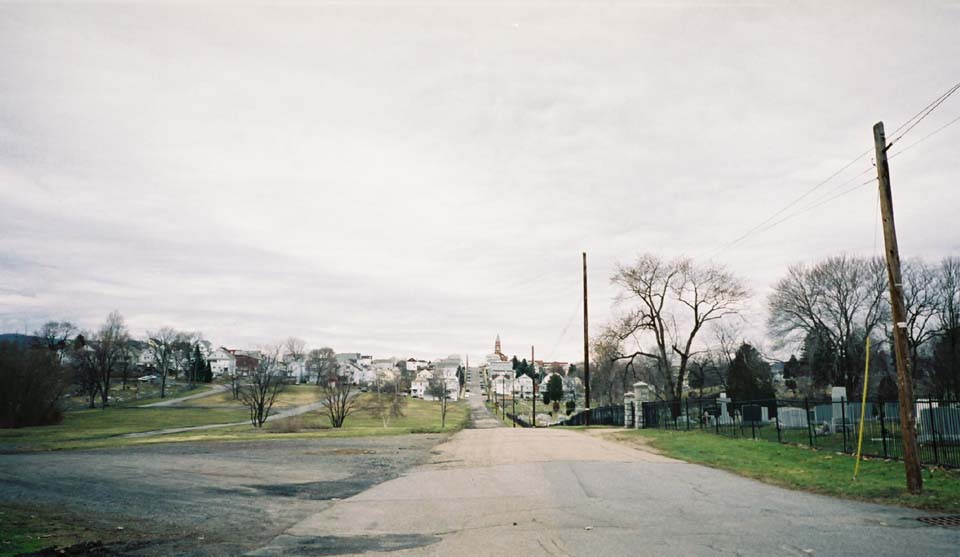
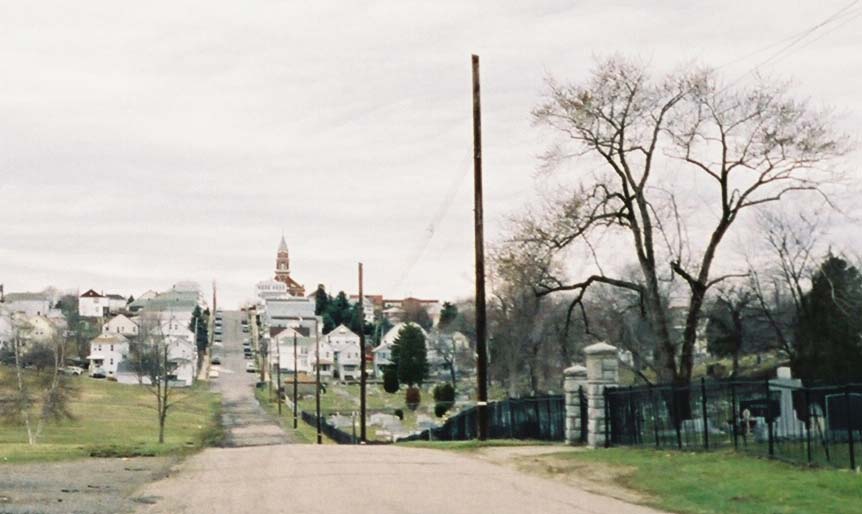
Our Lady of Czestachowa Church and School
(a.k.a. St. Mary's)
Nanticoke, PA

It was during these years that I began to question both Church and State. The Reagan administration was blatantly wrong on a great many topics from a moral and ethical point of view. The Church, as I saw it, was wrong on the issue of Liberation Theology, just as it was wrong on the issue of contraception. But still I went to Mass every week.

Our Lady of Czestachowah Church

After graduating from Scranton I went on to a brief but horrible semester as a graduate student at the University of Delaware. It was there that I realized I would not be able to fulfill my dream of earning a Ph.D. in Physics by age 27 and settling into a career of writing advanced science books for the general public.

There was a Catholic chapel on the campus of the University of Delaware. In Delaware Catholics are fewer and farther between than in Northeastern Pennsylvania, so despite the campus being several times the size of the U of S, Delaware's chapel was perhaps somewhat smaller than the campus chapel in Scranton. That chapel became my church for the two years of my exile in Delaware.

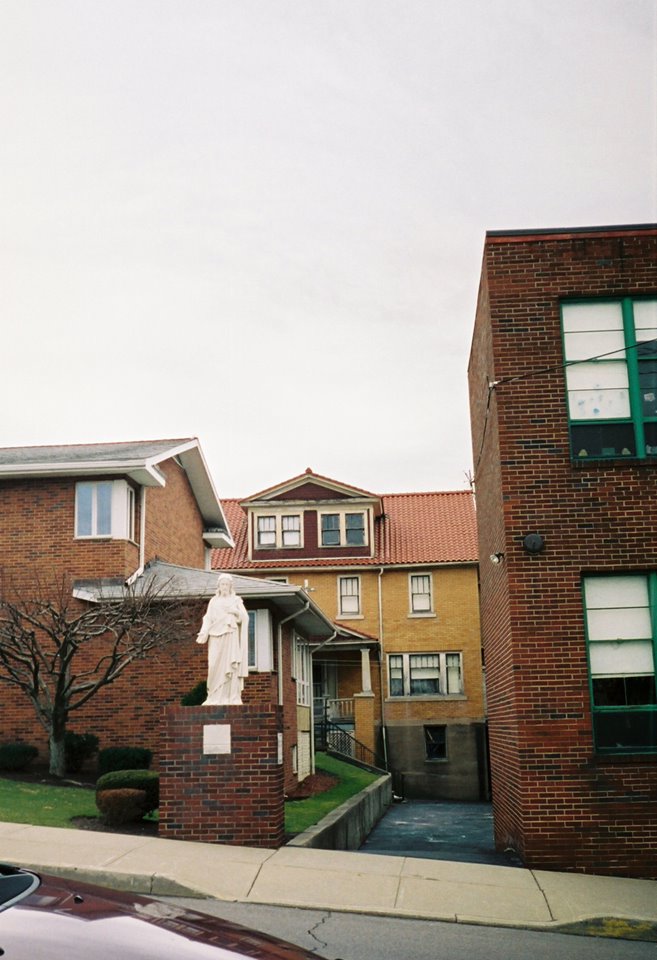
From left to right:
New Rectory (built in the 1980's)
Convent (disused for about 20 years, slated for demolition)
St. Mary's School

Upon my return to Pennsylvania I almost immediately took on the role of full-time caregiver to my 81-year-old grandmother, who was floored with a severe case of sciatica. Both of my parents were working full-time, my brother was taking classes to become a nurse, and my sister was living out-of-state. For more than six months this was my job, to wait on her and administer her medications and cook her meals and help her get to the bathroom or into bed.

I returned to the parish of my childhood to find things subtly different. Time had had its way with the parish, and many of the old faces were gone forever. The nuns were gone, too, as was the old rectory.

My grandmother eventually recovered from her sciatica, only to be felled almost immediately by a stroke.

Wind Tunnel and Nuns' Bridge

Strokes are terrible things. Her recovery was slow and incomplete. She returned to stay with us for several more years, until her condition had deteriorated to the point that she needed full-time medical attention.

My grandmother bounced from one nursing home to another. None of them were right for her, but in the end she settled into one that was more right than all the other ones. This one had one great advantage over the others, for her at least: it was a Catholic institution, and provided a daily and weekly Mass for the residents.

For the next few years this became my parish as I attended Sunday Mass with my grandmother. The Mass provided a continuity for her with her past, a continuity connecting the Catholic upbringing of her childhood with the daily attendance of the Mass in her adult years to the suffering and loss of freedom of her final years. She enjoyed it. At the Sunday service I would pull out some token cash for the collection basket, a dollar for me and a dollar for her. Once in a while she would look at the profferred dollar and say, "Put in five for me."

She died, as we all eventually will. I saw her body in the hospital early that morning - it was a Sunday - and went to the nursing home as soon as the doors opened so I could talk to the head nurse. She told me about how my grandmother had been talking and joking with the nurses when they came to give her medication early in the morning. An hour later they found her unresponsive and without a pulse in her bed. They had tried, frantically, to bring her back while they waited for the ambulance to arrive. They cried, she told me. They had all loved her vey much.

I looked at the clock. It was almost time for church.

I went to the nursing home's chapel. The chapel was not designed to accommodate a large number of wheelchair-bound attendees. Most Sundays my grandmother and I stood in the hallway outside of the chapel along with a dozen or so other residents. We had our regular spot, and other people had their regular spots, and we were all in more or less the same relative positions each week.

That Sunday I stood alone in our regular spot. People who didn't know before that my grandmother had died, knew then.

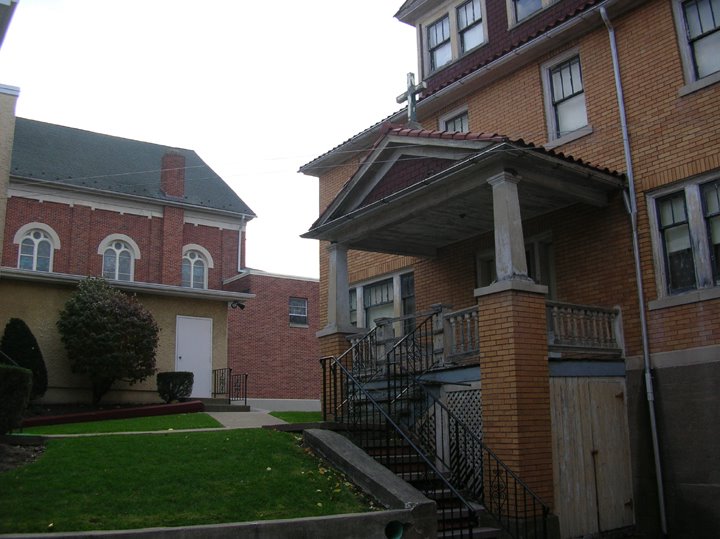
Convent

The nursing home remained my parish for several years after my grandmother's death until Masses there were discontinued as part of the ongoing diocesean implosion. Every once in a while I would remember my grandmother's periodic request and I would put six dollars in the collection basket - one for me, five for her.

After Masses at the nursing home were discontinued I returned, grudgingly, to the parish of my youth. I felt very little connection with it anymore. But still I attended Mass every week.

It was during one of these Masses that I had the closest thing I have ever had to a genuine religious experience. It was just after the Pope - Pope John Paul II - had died in 2005, during the Liturgy of the Eucharist, the portion of the Mass in which the bread and wine are consecrated and, we are told, transubstantiate into the actual body and blood of Christ. Looking at the ceremony, seeing the lights glint off the golden chalice and candlesticks, hearing the familiar words, I was suddenly impressed with the feeling that this was the moment that united all Catholics together. I saw all of the Masses being held everywhere in the world at all times in the past, present, and future, stictched together by this golden thread. As I pulled out of the mental rabbit-hole that I was pluging into headfirst, I thought to myself: This is the ultimate Catholic water-cooler moment.

Parishes are closing all around us. Father Piontek is dead, my grandmother is dead, my father is dead, my uncle, who was our church organist for many years, is dead. Father Krafchak is retiring in a few months, and the future of our parish is uncertain. I still believe that the Catholic Church is dead wrong about many issues. I hold out hope that God will someday steer the apostolic hierarchy in the right direction.

And I still go to Mass every week.

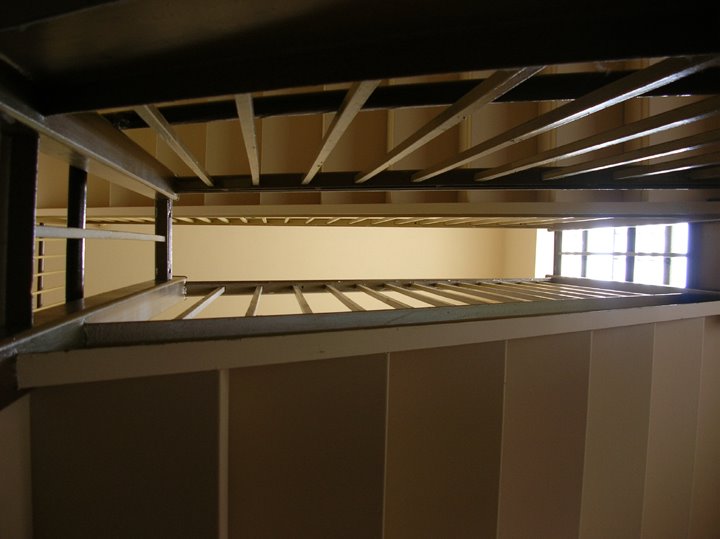
Rear Stairwell
St. Mary's School

This started out as something very different from what it became. It was originally to be an essay on religion and the politics of the Liberal blogger. Instead it became a meander through my life as seen through the filter of religion and, especially, the Mass. It comes as a surprise to some of my conservative friends and acquaintainces when they discover that I attend Mass regularly. Such a thing does not fit in with their preconceived notion of what a "Liberal" is or does. But they need to learn that "Liberals" are not bound to act according to either the preconceived notions of "Conservatives" or the confabulations of "Conservative" pundits and demagogues.

There are those who claim positions of moral superiority and yet behave in manners that are morally reprehensible. I try to avoid making any such claims, or behaving in any such ways. My religion is not the religion of the Pharisee who makes a great show of his piety so that others will be impressed. My beliefs are more quietely expressed through my actions. Who I am, what I believe, is what I do. I can make no stronger statement of the role of my religious beliefs in my politics than that.

Tuesday, October 19, 2004

Political and non-political humor

John Kerry was in Wilkes-Barre today. George Bush will be there later this week. Gosh, it's good to be loved. I can't wait until Election Day so we can be done with all this campaigning and get down to the lawsuits that will determine who will be our next President.

Kerry tried to tell a joke in Florida yesterday but he flubbed it. Here is what he meant to say. This is offered to his campaign free of charge.

"The Bush Administration's response to the flu vaccine crisis has been to adopt a faith-based health care approach: Pray that you don't get sick."

...which could then lead into the one about fighting a faith-based war, one based on belief in the existence of weapons of mass destruction rather than on evidence of their existence.

I spawned a new joke by myself yesterday. Well, I was fed the setup line, but the response was entirely mine. It was supposed to be an example of the sort of joke told at a party attended primarily by college professors:

How many college professors does it take to screw in a light bulb?
None. That's what graduate students are for.


I'm sure someone's come up with that before, but it's nice to imagine that it's an entirely new joke. Maybe my friend (the one who fed me the setup) will get to try it out at his college professor friend's upcoming party.

Wednesday, October 13, 2004

Dark sun rising

I left work at sunset today. This is something of a rarity for me lately, and I was fortunate that the sky was relatively clear - but not too clear.

I am easily turned around, and have a hard time determining north-south-east-west orientation without checking the position of the sun with respect to the time of day (or checking the constellations at night, the more obvious of which tend to cluster in the north and the south, at least as seen from my latitude.) It has taken me much of the past two years of working in my current location to determine what direction I am facing when I am coming in and when I am going out.

As I walked out of our plant's rear entrance this evening I looked at the setting sun reflecting off the cars in the parking lot, the ragged clouds scattered across the sky, and the rays of darkness seeming to emanate from a dark sun rising in the East.

Crepuscular rays, I thought. Shadows of clouds that have interrupted the light of the rising or setting sun. We often see sunbeams shining into the sky, or down toward the ground, but under very special circumstances - a critical density of clouds above the observer - these rays will manage to stretch clear across the observer's sky, appearing to diverge from where the clouds interrupt the sunlight and appearing to converge at a point directly opposite the sun.

The first time I saw this phenomenon was early in the two years I spent in Newark, Delaware, possibly during the single semester that I was enrolled in graduate school. I was riding my bicycle to the laundromat, a week's worth of dirty clothing strapped to my back in an Army surplus backpack*. I was riding north-by-northwest along a bicycle path and looked out at the setting sun, and saw the dark rays that seemed to extend from it. My eyes followed these rays across the sky to the opposite horizon, which is quite a trick when you're riding a bike downhill with a week's unwashed laundry on your back. And then I noticed...

The striped sky was full of birds. Literally full of birds, reaching out to the visible horizon in every direction. All sorts and sizes of birds. I had gotten used to the daily migrations of what I was told were Grackles, which flew in ribbon-like flocks that often stretched seemingly from horizon to horizon, but were only about a dozen birds thick. This was something different. The birds were not all of the same size or species, and based on my limited knowledge of ornithology, it looked like predator and prey birds were flying nearly side-by-side, although every bird seemed to maintain a healthy distance from its neighbors. The birds were spread out to the extent that if you briefly looked at a small part of the sky you might not notice anything unusual; you might, at first glance, think that you were just looking at a dozen or so birds flying from southeast to northwest across the sky. It was only if you swept your eyes across the sky, as I had when following the dark rays from the sun to the opposite horizon, that you could take in the whole spectacle.

I watched for a minute or so, thinking What the hell is this? After a while I realized I was not about to figure out what was going on, I was not going to see a fierce raptor swoop down on a little tiny insectivore, and I was not going to get my laundry done by staring at birds in the sky.

I moved on. The birds passed, the sun set, my laundry got done.

I never again saw anything like the vast convocation of birds that I saw that day. I still wonder about what brought it on.

Nothing quite so dramatic accompanied today's spectacle. Some people might see a dark sun rising as a bad omen, particularly one viewed three hours prior to the final Presidential debate. But it was a beautiful and remarkable thing, and I was glad that the events of today conspired in such a way that I was there to see it.

*I believe this memory is faulty, that I didn't have that particular backpack until I had been in Delaware for about six months. But I don't remember what I used prior to the Army backpack to lug laundry and groceries. Let's just pretend it was the Army backpack and move on.

Wednesday, June 16, 2004

The Scientist

This is my favorite photo of me as a little kid. I think I was maybe 3 or 4 when this picture was taken. And, like most things, there's a story behind it.


Me with Monarch Butterfly Posted by Hello

I had been playing in our back yard and I spotted a Monarch butterfly in our garden. I wanted to reach out and touch it, but my mom shouted "Wait!" and ran back into the house. (This was in those long-ago days when you could leave your child in your own back yard for upwards of several minutes without worrying that somebody was going to come along and do something horrible to him.)

She came back a few seconds later. "OK, now!" she said, and I continued to reach out to the butterfly. It was so beautiful, so delicate, like something made of living paper. I wanted to touch its wings, to see what it was made of.

This picture really gets at the heart of who I am. Curious, fascinated by the natural world, tentatively reaching out to engage it. A three-year-old Naturalist. A budding Scientist.

I don't remember exactly what happened next. I swear I didn't crush it or do anything else to kill it. But I do remember that the butterfly flew away a few feet...and then dropped out of the air, dead.

Yeah, that's me, too! Can't engage the world without causing some sort of damage.

Of course, I was horribly traumatized by the incident.
***
I may have made up for this crime against butterfly-kind many years later. How many years later, I just realized.

It was during my brief and horrible stint in graduate school. I was in grad school for a few months when I was 21, and dropped out shortly after my 22nd birthday. I am now 36. Assuming I was 3 when this picture was taken, there was a span of 18 years between this picture and my grad school experience. 15 more years have passed from then to now. In just three more years, there will be as great a distance between the present and my grad school experience as there is between my grad school days and this photo. Phreeow.

It was Autumn, maybe a month into the semester. I was walking the mile-and-a-half from my apartment to my office on campus when I came across an injured Monarch butterfly. Monarch butterflies taste terrible (or so I am told), and are brightly colored to warn predators away...don't bother, their colors say, go try eating somebody else. Not all predators get the message. Apparently one hadn't in this case; it had taken a chunk out of one of the Monarch's wings and spit it out, leaving the butterfly crippled and flightless.

I picked up the wounded butterfly, and it clung to me like a desperate child. I thought, what the hell, and carried it with me the rest of the way to my office in the Physics building.

I happened to have a broken pocketwatch whose glass face had popped off at my desk, so I decided to turn it into a butterfly feeder. A few grains of sugar and a little water, mixed together with a coffee stirrer, became a poor substitute for the nectar the Monarch would have stocked up on before the long flight to its breeding grounds in Mexico - a flight that now it would never take.

I coaxed the Monarch onto my forefinger and then thought about the problem of how to convince it to drink. I vaguely remembered that butterflies taste with their feet, so I thought this would be a good place to start. I maneuvered my finger so the butterfly's front feet waved in the air, then gently touched them to the sugar water. It moved the delicate clawed sticks of its forelegs tentatively in the mixture for a few seconds, and then, amazingly, its coiled proboscis gradually straightened and extended and reached into the liquid. It sucked up the sugar water until it had had its fill, and then recoiled its proboscis and pulled back from the watchglass.

Sugar water does not contain the nutrients necessary for butterfly survival. You should never fill a butterfly feeder with colored sugar water; you will be doing the poor insects a disservice. But I did not have the means to acquire the proper solution, and I did not expect my rescued butterfly to live very long. But it did live, in a hutch above my desk, for something like two weeks. I would occasionally take a break from studying or preparing labs or grading papers to let the butterfly cling to my finger as I inspected its insect anatomy. Sometimes I would blow softly on its wings, and it would tense its broken wings and flap them gently, perhaps remembering the sensation of wind and flying that would be denied to it for the rest of its life.

And after a time, it died. I came back to the office one afternoon to find it still and lifeless. I felt a little sad, but also felt that in some small way I had repaid a debt to a butterfly that may or may not have died because of me some 18 years before.

Saturday, May 15, 2004

A little bit about me

Let me tell you a little bit about myself, so you might have some small inkling of who is writing this blog. (I sense that this posting will be extensively edited and rewritten until I am happy with it.)

I am an ascetic hedonist. I believe that the simple pleasures of life should be enjoyed to the point of wretched excess.

I try to be virtuous, temperate, and industrious, yet at various times I am the embodiment of five of the Seven Deadly Sins: Sloth, Gluttony, Wrath (more a sort of Mr. Furious impotent rage), Pride, and Lust. Greed and Envy usually aren't a problem for me, although I have a strange trait of being excessively miserly with myself and excessively generous with others. This is actually because money frightens and confuses me, and this is the way this fear and confusion express themselves.

I have a mild touch of synesthesia. This is a cross-wiring condition in the brain that causes the inputs of one sense to be experienced through another. For me it's usually a case of visual stimuli having a musical component. I can "hear" a sunrise or sunset as a chorus. It works in reverse, too...music can generate images in my mind's eye, especially during the periods of going into or coming out of sleep. (Coldplay's "Clocks" has a strong visual component: a large wheel, like a roulette wheel, with a rotational period equal to the repitition period of the opening piano notes.) This results in some careful self-editing of verbal descriptions that I give to other people - I need to phrase what I see in terms they can understand. I think a lot of people actually experience this and just don't talk about it.

I also suffer somewhat from Prosopagnosia. This is a condition also known as "face-blindness". I can't remember major specific details of a person's face. If they have huge scars, or bad teeth, or an enormous, misshapen nose, I can remember that no problem, but otherwise my recollection of faces is "He has a head shaped like an apple...with a chin...two eyes...brown hair, or maybe blonde...." Any description I can give is usually a record of imperfections. I have never been able to draw specific faces...general faces, yes, I can construct a face wholly out of imagination, but don't ask me to sketch your face, or you'll wind up with something generic and abstract, or something technically similar to your face, but lacking in humanity. I can usually recognize people in specific situations (work friends at work, friends in their own houses, friends of friends because of the people they associate with), but in the wild, I can sail right past a friend without recognizing them, or (more frighteningly) think I've made a "match" with a friend's face when in fact I'm looking at a total stranger. Surprisingly, I can often recognize people based on their hair color and style. I usually tell people that I have a very small memory buffer, and it fills up from the top down, so by the time I reach the face, it's full. For some reason, this condition also affects my ability to recognize cars. Good thing we have license plates.

I am also somewhat dyslexic, particularly with numbers, although this usually comes into play when I am tired or stressed. A lot of other people I know have the same problem to varying degrees. Most of them, however, didn't major in Physics in college or have a series of jobs that deal extensively with numbers!

I actually double-majored in Physics and Philosophy in college, at a Jesuit University where such a thing was possible. After college I went into a graduate program in Physics, which I almost immediately washed out of. This was the first major failure of my life, and one of the most painful things I've ever gone through. Maybe I'll tell you all about it sometime.

Politically I am a registered Independent, but in practice am a Liberal. What exactly this means I haven't yet decided. I'm not willing to grant Conservatives the right to define what a Liberal is. I also have pretty strong views about the Bush administration, which you'll certainly be hearing about eventually.

Religiously I am a Jesuit-trained semi-agnostic lapsed Catholic. I might add junior-level Taoist and (I have been told) Deist to that list. I was raised a Roman Catholic and still attend mass weekly at the chapel of the nursing home where my grandmother lived out her last years. But I have strong issues with some of the proclamations and positions stated recently by the bishops, allegedly by the pope, and by various scholars. I learned a bit about Taoism in college and have always recognized resonances within myself. I just looked up Deism for the first time ever a few minutes ago. After I described my personal beliefs during a late-night bull session with some friends last year, one of them pointed out to me that I was describing Deism. I knew that many of the American Founding Fathers were Deists (and not the Christians zealots that many modern-day Christian zealots try to portray them as), so maybe I'm among good company.

In appearance I am big. I'm short for my weight, which through extrapolation from actuarial tables would indicate that my weight is optimal for a height of something like 9'3". I have lost weight in the past through a disciplined program of diet and exercise, but lately I just haven't felt like putting in the effort. Maybe I will start it up again, sometime soon. I'm also broad-shouldered, which comes in handy when you need to block a doorway. I'm seriously big-boned, with a thick skull that can probably split yours open like a melon, buster. Which is all pretty funny in that I drive the smallest car Toyota produced 8 years ago, while tiny people around me feel the need to compensate for their private shortcomings by driving gas-guzzling Sheik's Delights.

Well, that's that. Off to meet some friends for sushi. Talk to you later!