Showing posts with label Critters. Show all posts

Monday, July 17, 2023

Fireflies

A memory I want to preserve before it fades.


The Word to Word poetry reading on Friday, July 14 went off very well.The structure of the reading is unusual: three poets blindly send four pieces of poetry each to each other, and then endeavor to order them in a way that makes sense. The idea is that the poets will be "in conversation" with each other through their poetry. The problem was that we are three very different poets, and our poems touched upon very different topics. After weeks of pondering this, I noticed that many of the poems mentioned or could be placed in a time of day: the hours before sunrise, midday, the afternoon, dusk. That suggested an order that gave a nice flow to the poems, and gave the final poems a synergistic punch. The four that I chose were "Night, April 21, 2020" (set at 4:00 in the morning), "dancer" (which can be found here), "Ora Pro Nobis," and "Cardinal."

When the reading was over I made my way back to the car. I had had nothing to eat but a large stack of French Toast at midday, and now, nearing on 8:30 PM, I was hungry. I stopped at Burger King, the Burger King where my mom and I would sometimes stop to grab a quick lunch after one of her appointments. I got my usual two Whopper Juniors (two for $5) and splurged on some fries. I noticed a skinny gray-and-white cat in the parking lot, picking at a scrap of food. I tore off a chunk of one Whopper Junior and psspss'd to the cat. It watched me with curiosity until I tossed the meat in its general direction, at which point it retreated to the forested area behind the Burger King. Maybe it came back out to grab it before anything else did. Maybe.

I stopped at a supermarket on the way home, fifteen minutes before it closed. (The supermarket and its parking lot were a setting for a previous story involving a cat.) I dashed in to buy a horrible list of groceries: one small package of half pork-half beef to make meatballs (I was really looking for ground beef, but they were all out), two bags of potato chips (Middleswarth Weekenders, once 14 oz., now just 9 oz.), one container of ice cream (once a standard half gallon size, then 1.5 quarts, now 1.44 quarts.) I made it to the self-checkouts just as the store closed.

I came home and packed up the remains of my late supper  and my groceries, locked the car, and proceeded up the hill to my back door. 

As I climbed the hill I was greeted with a light show: dozens of fireflies, some airborne, some on the ground, all flashing their HEY BABY WANNA HAVE SEX? lights at each other. I chose my steps carefully, not wanting to tread upon any of the luciferous insects. I wished them well in their reproductive endeavors as I walked up the hill. May they be fruitful and multiply. 

Lord knows we need more of their kind to light up our summer nights.

Saturday, June 19, 2021

In the Year of Brood X, 2021


Cicada on my cherry tree, June 19, 2021


I have been blogging for seventeen years. My first "official" blog post was May 14, 2004 - there had been another post a few days earlier that just said "Coming soon - Another Monkey with a blog!", but I deleted that after I officially started my blog. 2004 was a Brood X year, another year in which the Brood X cicadas emerge during the final stages of their seventeen-year cycle, and they were the subject of my twenty-fifth blog post on June 9, 2004. The cicada eggs that were laid that year grew up to be the cicadas of this year.

(I was in college during the previous Brood X cycle in 1987, and spent that summer at the TV faceplate factory in Pittston where my father worked. I remember cicadas thudding off the windshield of our car as we made the commute to work. I was two years old during the Brood X emergence before that one, and don't have any memories of it.)

I have been hearing cicadas for the past few weeks around Nanticoke, but had only seen a single one (flying near the top of one of my cherry trees) up until yesterday. The cicadas seem to be concentrated in the area alongside Route 29 on the east side of town, although there are also some along Middle Road to the south and possibly some along the river flats to the north. In large numbers they emit a sound that sounds exactly like one of the dozen or so sound effects that were used for phasers in the original TV series of Star Trek. Individually they sound like an electric drill being used in short bursts, to the point that many people assume that this is what they are hearing: some rude and thoughtless neighbor using power tools at all hours of the day and night, over and over.

Yesterday I went for a ride to the Hanover Mall to get some specialized pet food for our fifteen year old cat Babusz, who recently had an incident of odd behavior - she suddenly abandoned her usual hangout spots and went into hiding, choosing to isolate herself in odd areas around the house and refusing to accompany my mom to the bathroom, as was her custom. She did this for about two weeks, and then gradually began to emerge again, spending some of the day in her old usual spot on a rocker near where I work, racing my mom to the bathroom some (but not all) of the time. But since she emerged she has been losing weight. We'll get her to the vet soon, but having lost four cats in the last twelve months I fear the worst. At my sister's recommendation we are trying a new food/treat, Churu by Inaba. She has gradually taken to it. Our grocery store doesn't carry it, by Village Pet Supplies in the Hanover Mall does.

Babusz, July 12, 2020

The Hanover Mall is just the other side of Route 29. When I got there, I stepped out of the car and into the cicada chorus, providing a science fiction-y background to the mundane scenes of people getting out of their cars or loading purchases into their cars. I saw another cicada in the air as I parked the car.

Reports are that cicadas are absent from many areas around Northeastern Pennsylvania where they had been seen seventeen years ago. Development has disrupted and destroyed many of the underground cicada sites, eliminating whole breeding populations. NEPA is at the edge of the Brood X emergence territory, so things can be a bit more iffy here as to whether cicadas will actually show up anywhere. 

Today I went to a poetry reading, the first event I have gone to since February 22, 2020. I stepped out of the house with my Chromebook in its makeshift carrying case and my old-and-getting-older Nikon Coolpix P520. On my way to the car I heard the familiar buzz-flap of cicada wings, and watched a cicada alight on the cherry tree next to me. (My cherry trees produced their first decent crop of fruit in several years, though the cherries just ripened earlier this week and the birds have already eaten everything I didn't pick.) I carefully dropped the Chromebook, broke out the camera, and coaxed out two decent photos: 


I don't know how much longer the cicadas will be around, singing their song. When they are gone, we will not see Brood X again until 2038. If I live that long, I will be seventy years old. Will I still be blogging then?


Tuesday, October 09, 2018

Spinning wheels


I spent most of the day doing stuff - several loads of wash for my mom, running them up to the laundromat to be dried. I had some stuff that I ordered for her waiting at a store, and while I was there I got a haircut.


I guess that's job search related.

* * * * * * * * * * *

Tonight I heard some odd noises on the back porch after I had put out food for the neighborhood feral cats. (There are two, Little Girl and Mister Black. Sometimes Mister Yellow comes by for food and to vie for Little Girl's affections. Sometimes it works. She is safely unable to have kittens, thanks to a trap-spay/neuter-release program eight years ago.) What I heard on the porch were not cats but enormous raccoons, the size of medium-large dogs - let's say wolves. Two of them, squeezed together side-by-side in the doorway, eating the dry food. Each time they chewed they seemed to be snarling. They stared at me with their bandit-mask eyes for a bit, and then the second one reached out with a clever forepaw and started to drag the bowl of cat food off the porch. I yelled and approached them, and they retreated from the porch.

Friday, May 04, 2018

Lilacs, May 4, 2018

This morning (actually, it was about 1:00 in the afternoon) I saw our next-door neighbor for the first time in weeks. I told him about the shingle going through our window, and pointed out that someone had apparently picked up all of the shingles from our front yard as though to hide the evidence. I also then pointed out that the lilac growing on the side of our porch was almost in bloom - its blooms were out but hadn't taken on their characteristic lilac color yet. Soon, I realized, it would be in full bloom.

"Soon" turned out to be about four hours.

Image may contain: flower, plant, nature and outdoor

A lucky double capture: the freshly-bloomed lilac already being set upon by a friendly neighborhood bumblebee.

Image may contain: flower, plant, tree, house, outdoor and nature

The same lilac from a slightly different angle.

Image may contain: plant, flower, outdoor and nature

Aaaand the reverse angle. Look at those antennae! 

Already the cherry and magnolia blossoms are falling, and the daffodils are fading. But it won't be long until blueberries, azaleas, and irises are in bloom!

Tuesday, March 20, 2018

The last male Northern White Rhinoceros has died

It's been a nearly a third of a century since Douglas Adams and Mark Carwardine set out on a mission to document some of the most endangered animals on Earth, a project Adams wrote about in his book Last Chance to See. Some of the animals described have maintained their numbers, or even made a slight recovery. Others, like the Baiji dolphin, have slipped away into oblivion.

The Northern White Rhinoceros, so precariously close to extinction in 1985, showed some small increase in numbers in the decade that followed. But political unrest and relentless poaching quickly reversed any gains, and numbers were reduced to the point that the Northern White Rhinoceros was declared extinct in the wild in 2008. A last-ditch effort to save the species was declared: all individuals being held safely in zoos throughout the world were recalled to their ancestral homeland, the idea being that they would be more likely to reproduce in their natural habitat. This turned out to be an enormously bad idea, as many of the repatriated rhinos were quickly picked off by poachers. The few survivors were placed under around-the-clock guard.

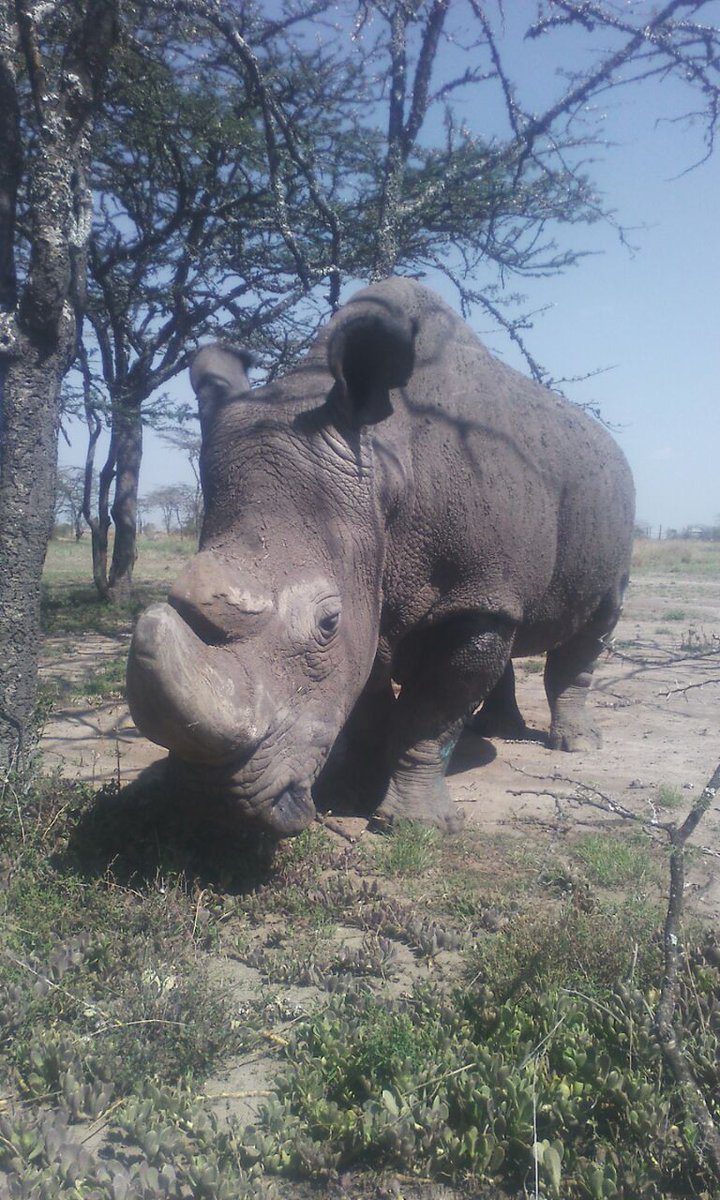
As of yesterday, the global population consisted on one elderly male, one sterile female, and one female incapable of bearing young. As of today, Sudan, the last living male Northern White Rhinoceros, is dead.

This is not something that just happened. We were warned. We knew what would happen. We could have taken steps to avoid this outcome. There was nothing inevitable about it, until there was.

As of yesterday, a week ago, a month ago, the Northern White Rhinoceros was effectively extinct in captivity. The three remaining individuals did not constitute a viable population by any stretch. Losing one of them does not change that reality. They were not representatives of the hope for the survival of a dying species. They were living reminders of our guilt and failure.

Now there is one less reminder.

Sudan, the last male Northern White Rhinoceros.
From the Ol Pejeta Conservancy Twitter page (https://twitter.com/OlPejeta)

Tuesday, March 13, 2018

Tired, part whatever

I've been working 6:00 AM to 2:30 PM Monday through Friday for the past few months. That may end at the beginning of May, but for now, that's the shift I'm on.

For various reasons I need to be out of bed about three hours before the start of my shift. These days that means waking up at 3:00 AM. That's a pretty brutal hour to be awake, but at least ABC still has their tongue-in-cheek overnight news program World News Now to help me get started. Until this weekend, I was generally in bed by 9:00 PM to get a solid - and by solid I mean frequently interrupted - six hours of sleep. But since the "Spring Forward" of Daylight Saving Time began on Sunday morning, I find myself staying up to 10:00 PM - but still waking up at 3:00 AM.

Today I worked overtime for the first time in several weeks. I signed up for two hours, 2:30 PM to 4:30 PM. I clocked out after my last call at 5:15 PM.

********
This morning I saw that the food containers on our back porch, left out for the remaining feral cats in the neighborhood, were mostly empty. I topped off the dry food, refilled the water dish, and made a mental note to put out wet food after I did everything else. I then went through the morning routine: started the coffee, fed the cats, ate breakfast, read the funnies., made my lunch. I took the bowls of leftover food from the inside cats, the stuff they didn't eat overnight, and topped it off with the food the outside cats like. I filled two bowls and went to take them outside.

That's when I saw a skunk and an opossum eating side-by-side from the double-sided dry food bowl.


I ran for my camera, but wasn't fast enough. The best photo I could manage shows the opossum exiting the porch while the skunk -wearing some Christmas garland, from a failed effort to keep the birds from stripping all of the cherries from my cherry tree - tries to hide. A few minutes later, I was fairly sure the skunk was gone, so I put the wet food out. 


********

Trump fired Rex Tillerson as Secretary of State today. Tillerson learned about his firing through a tweet from Trump that casually mentioned his replacement. A lot of people are surprised and flummoxed by this. But, honestly, if you're still surprised by anything Trump does, you haven't been paying attention.

America, you fucked up. I hope we can survive this.

Monday, February 01, 2016

Seven days of nature photos, day 5: Ants, locked in combat


For day five of the seven day nature photo challenge, I'm doing something a little different. My photos so far have focused on beautiful aspects of nature that are easy to overlook, sun pillars and the shadow of the Earth, an Ambush Bug hiding in a rose and a Full Moon emerging from a cloud bank. This photo is also something easily overlooked, but not quite so beautiful. A great ant battle, hundreds of ants locked mandible to mandible, the dead and dying all around. Why was it happening? I have no idea. I just happened to witness it, and just happened to have a camera on hand.

The original post, from April 23 2007, can be found here.

Thursday, January 28, 2016

Seven nature photos, day 1: The Lurker in the Roses

A friend on Facebook has invited me to take part in an online exercise, to post seven nature photos in seven days. This is an easy enough challenge, but he further suggested that I do it using photos from posts on my blog.

I decided to take up this challenge, starting with my earliest posts and working my way forward. I was a little surprised to find that very few of the 172 posts from 2004, my first year of blogging, contained any nature photos. 2005 did a bit better, and I found myself with several candidate posts.

I selected this image:


It's a simple enough photo of a rose from the Royal Highness bush I had planted a few years earlier, back in the late summer of 2001. But it was taken on the day my father died, so there's a story that goes with it. And there's a surprise hidden in the image, something I had never seen before, and have never seen since. You can read all about it in my original post, The Lurker in the Roses, from August 30, 2005.

Monday, October 13, 2014

A bird on the face of the Moon, October 9, 2014

Early in the morning of October 9, about eighteen hours after I had photographed that morning's Lunar eclipse, I went out to get photos of the just-past-Full Moon.

I prefer to use a manual setting when I take pictures of the Moon when it is close to Full. The manual setting takes sixty frames per second and creates images that are a bit dim compared to the automatic setting. This reduces the blinding glare of the Moon and allows subtle details that would otherwise be washed out to be visible.Unfortunately, it also puts the camera into a "widescreen" mode that reduces the overall image area to something that some of this Summer's "Super Moons" haven't been able to fit in. So it's very easy to cut off the top or bottom of the Moon in a standard landscape photo.

I was interested in capturing the subtle and not-so-subtle differences in the shadowed regions (on the right in these photos.) I set up the shot as best I could, centered it as well as I could, set the ten second timer, pressed the button, stepped away -  and watched with annoyance as the image on the screen showed that the Moon had slipped slightly out of the frame.

I also noticed something else - a speck that appeared after about five images, moved across the face of the Moon, and disappeared halfway through the shot.

I had captured a bird crossing the face of the Moon.


The Moon is big, really big. But it's quite small in the sky. Even in its extra large "Super Moon" state it still appears barely larger than an aspirin or the eraser at the end of a pencil held at arm's length. Now, look at how small that bird appears against the face of the Moon, and imagine how incredibly tiny it appeared in the sky. And yet I caught it as it flew between me and the Moon!


Photos of birds crossing the face of the Moon are not uncommon, which tells you something about just how many birds there are flying around at night. Still, the odds of getting one crossing your shot as you take pictures of the Moon seem...well, literally astronomical.


This bird appeared in twenty-six of the sixty images in that burst of photos. In most of them it isn't doing anything very interesting. In fact, it seems to be dropping like a rock with its wings either edge-on to the camera or completely folded back against its body. Starting with the first image and ending with the third image above, here is every third image in the sequence. (No wing flapping is apparent between any of these images.)


Wednesday, March 12, 2014

Poem: blossom


blossom

I saw a black blossom floating in a bird bath once
it had red and pink petals spreading out in the water
and a long pink stem behind
and, on closer inspection, little feet attached to little legs
and I realized it wasn't a blossom at all
but the back half of a rodent
a mouse, or rat, or (as I would later determine)
a vole, a cute chubby little creature with a fondness for the cocoa hulls
I was using to mulch my blueberries.

It had been going about its vole-ish business one day
when some keen-eyed bird spotted it
a hawk, most likely
and snatched it up to have it for lunch
But the rodent struggled mightily, fighting for its life,
forcing the bird to expend energy just to hold onto this bit of food
and in the end it decided that half a vole was better than none
and it bit the vole in two, flying off with the still-struggling front
and leaving the back to fall into a birdbath
where its guts spread out like red and pink petals in the water
and its tail stretched out like a stem
and it floated there, waiting for me to find it


This poem was first presented at the Kick Out the Bottom Open Voice reading at Embassy Vinyl in Scranton on February 28, 2014. I got the idea to write it at the previous month's event - though, as you'll see, most of it already existed years ago.

I prefaced this by saying "I think I'm starting to get a reputation of something of a love poet. So I've decided to do something different - a poem about nature." Most people laughed, possibly expecting an ode to nature, not something about nature red in tooth and claw and beak and expanding guts.

I knew I had written about this incident previously. It's described in one of my most-commented posts, "The Strange Case of the Headless Rabbit":

...A few years ago I saw my first vole, sort of, in a birdbath. Actually it was half a vole, the back half. I thought it was some sort of strange blossom that had landed in my birdbath, with a short stem and a black bud and a red blossoming flower. The "stem" turned out to be the vole's tail, the black "bud" was its back half, and the red "blossom" was just its guts spreading through the water. Ah, isn't nature lovely?
I figured some bird of prey had swept down and snatched a hapless vole as it scurried across my lawn towards the safety of my garden shed. The vole, a fat mouselike critter, put up a valiant struggle as the bird perched on the birdbath and gathered its strength to carry the rodent off in its beak. Maybe the vole scored some points with its sharp little teeth. (I had a vole bite me once, when I caught one just outside my garden shed and picked it up to study it. Dumb.) The bird, growing annoyed, realizing that it was in danger of losing its meal, and instinctively understanding the rapidly diminishing net energy gain from this food source as it subtracted out the increasing amount of effort being expended to secure the food source, made a snap decision and bit down hard with its powerful beak, cutting the vole in half and ending its struggles. Pleased with its decision, it let the part of the vole that had been outside its beak drop into the birdbath and flew off to consume its meal, or perhaps share it with a mate or its chicks...

That was written on April 22, 2006, and described an incident from several years earlier - possibly as far back as 1998 or so. Sometimes it takes me a long time to work something into a poem!

Tuesday, August 21, 2012

Coyotes and turkey vultures

I grew up in Northeastern Pennsylvania in the 1970's and 1980's, but it wasn't until the late 80's or early 90's that I recall ever seeing a turkey vulture or hearing about coyotes in this area. Nowadays turkey vultures are in the sky every day, and coyotes are common too. It's not like I wasn't paying attention - I have a vivid memory of a Sunday in 1979 1978 when hundreds of seagulls descended on Nanticoke (PARADE magazine featured a cover story on Star Trek: The Motion Picture that day.) So is it my imagination, or are these animals more common in NEPA than they once were?

In a highly peripatetic society, it's increasingly difficult to find many people who have been in any one place long enough to have observed the gradual (and sometimes sudden) changes that the decades have brought. What about you? Have you noticed specific environmental changes where you live?  Leave a comment describing what you've noticed!

Friday, August 12, 2011

In the time without bats

Bats are virtually extinct in Nanticoke, and possibly throughout Northeastern Pennsylvania. While some people who live in the country have reported seeing some bats, they have been completely absent from the low skies of Nanticoke as twilight darkens into night. Up until now they have been a part of the ecosystem here, flapping in seemingly erratic paths across the not-quite-dark sky in search of insects. But now they are gone, apparently all of them.

Friday, July 15, 2011

Pseudoscorpion on the ComposTumbler

Today was a big gardening day. Lots of weeding, lots of stuff going into the compost. Before I got started on that, I decided to empty my thirteen-year-old ComposTumbler and use the finished compost to mulch my tomatoes.

I had to hack my way through a jungle of Rose of Sharon to get to the front access hatch of the tumbler, and then scooped out the contents using an old pot that was retired from service years ago. The compost had finished nicely: crumbly, fine-grained, smell-free, with only a few of the compost balls that tend to form from the tumbling action of the ComposTumbler. I left some of it in the tumbler, partly to serve as a starter for the next batch of compost, partly because it was too hard to reach in and scoop everything out.

I was in the process of refilling the tumbler with some freshly-picked weeds and a pail full of kitchen scraps when I noticed a tiny insect on the side of the ComposTumbler. It looked like just some garden-variety insect critter except for one thing: it had two extensions on the front that looked for all the world like the claws of a scorpion.

I looked closer, thankful that my bifocals allowed me to focus on tiny things at close range, and saw...that I was going to need to grab my camera.


Friday, July 30, 2010

Tobacco hornworm

My cousin found this big fella chewing on her tomato plants. From the picture of something similar in my bug book (National Audubon Society Field Guide to Insects and Spiders) we believe it is a tobacco hornworm, though it may also be the similar and closely-related tomato hornworm. (According to Wikipedia, the seven lines on its side mark it as the tobacco hornworm; eight V-shaped marks would make it a tomato hornworm.)


My cousin caught it and kept it in a sealed jar with some leaves and a small twig. By the time I got to see it we thought it was dead, but it sent a pulse through its body during the photo session that convinced me otherwise. My Nikon Coolpix L4 is usually pretty crappy when it comes to close-up mode, generally focusing perfectly on the background and leaving the foreground object a blurry mess. We fixed that with additional lighting provided by one of those million candle power spotlights, which my cousin keeps to illuminate woodland creatures visiting her back yard.

Appropriately enough, we propped the tobacco hornworm and its twig on top of an ashtray. The end of a cigar in the ashtray gives a sense of scale - this was a big critter.

Friday, July 16, 2010

Driving Mr. Groundhog

Yesterday one of our cats got loose. His name is Spooky, and he is a black cat with a scattering of individual white hairs, including one white whisker. We found him after some effort, hiding under a tarp under a rhododendron. But before that discovery we set out our Havaheart trap baited with cat food, hoping to catch him. Two weeks ago he got out without anyone noticing and turned up in the trap that we had set out for a groundhog, baited with an apple. We found the apple outside the trap, and him inside it. He apparently went into the trap to play with the apple, batted it out, and tripped the mechanism.

We never bothered to unbait the trap this time. This morning it was still positioned in the front garden where a groundhog had dug a burrow next to our foundation. Groundhogs may seem like annoying but not especially dangerous herbivores, oversized relatives of squirrels and chipmunks, but in reality their extensive burrows can cause considerable property damage and even undermine foundations. So when we discovered that we had caught something overnight, I wasn't too upset to see that it was a groundhog.


We caught a groundhog once before. It was a big, cheeky fellow, who was really not very pleased about being in the trap. The groundhog who has been menacing our neighborhood lately is also a big bruiser. This was a smaller specimen, who I have since dubbed Groundhog II: Son of Groundhog. It might not have been the groundhog, but it certainly was a groundhog.


So now the question was: what to do with him?

The last groundhog we caught we drove to a semi-remote forested area several miles away and released him. And that was good, but...I've always had a sinking feeling that the groundhog could retrace our steps and make it back. Based on no information at all, I have decided that groundhogs (like ghosts) cannot cross running water. So it seemed to me that the best thing to do would be to take him across the river, through the mountains, and along a creek to the area of Moon Lake Park and release him there. If they're going to do gas drilling there, may as well lend them a hand. Or some paws.

Yes, this should do.

I wasn't in a hurry. I took my time eating breakfast and getting myself and my car ready. I laid out an extra tarp on the back seat, rolled down all the windows, put on some leather gloves, and after showing our "latest acquisition" to a neighbor loaded the trap into the back seat. As I did so I had an awful thought: I hope there's no way he can get out of there.

It was a longish drive, with me playing Morgan Freeman to the groundhog's Miss Daisy. (He wasn't much of a talker.) At no point did I consider letting the groundhog take the wheel, despite suggestions from friends.

This is why.

I missed the park. It's been well over twenty-five years since I was last there, which is a bit of a shame. I drove until I knew where I was - briefly considering letting the groundhog loose on the lawns of the rich bastards who have cut off all public access to Lake Silkworth - and backtracked until I found the sign marking the entrance to the park. I drove up to the park, noting the general lack of traffic along the access road as well as the broad open fields and densely forested areas along the way, a nice, safe place for a young groundhog to start a new life. I turned around in the park entrance, drove back down the access road a little, pulled off the road, and released the groundhog. He immediately dashed across the road and, I hope, to safety.

Now we'll see if any of his relatives come around seeking revenge. Or perhaps he will make it back somehow, and we will witness Groundhog III: Return of the Groundhog.

Saturday, April 24, 2010

The golden spiderlings

While mowing the lawn this afternoon I noticed the lid on my composter was askew, despite the paving block I have on top to keep it from blowing off. When I went to adjust it I noticed a spider web on the block and the lid, apparently clogged with pollen. Then I noticed that the pollen was moving. I went back in the house and grabbed my camera.

The things that I thought were grains of pollen were actually baby spiders, about a millimeter and a half long. Each was golden yellow with a black spot on the abdomen, the rear section.


On closer inspection of the photos, the black spots appear to be spinnerets, and the spiders' eyes appear to be red - some of them, anyway.


I don't know what variety of spider these spiderlings will grow into. Most of them are fated not to grow up at all. Life is harsh for little spiderlings.

Wednesday, June 24, 2009

Tree Frog in the garden

I worked all night last night, met an old college professor for breakfast, went on a shopping expedition for comic books, whiskey, and gardening supplies, came home, and mowed the lawn.

My mom came out to prune the Rhododendrons while I was mowing the side yard. Shortly after she started she began to signal to me frantically to come and see something. There was something in the Rhododendron she had never seen before - and neither had I, except in pictures. It was a tree frog.


I plucked the frog from its leaf and ran in the house to get my camera. What was a tree frog doing here in Pennsylvania? I had always assumed these were a tropical sort of species. But it turns out there are several tree frogs among the seventeen species of frogs native to Pennsylvania.


This particular tree frog most closely resembles the description given for Cope's Gray Tree Frog*:


Description 1 1/4-2 3/8" (3.2-6 cm). Skin rough; greenish or brownish to gray, with several large dark blotches on back. Dark-edged light spot beneath eye. Under surfaces of thighs bright yellow-orange. Large toe pads.

Certain aspects of the description do not match up exactly:


Habitat Trees and shrubs growing in or near permanent water.
Hmmm. No permanent water I know of, unless the recent rains have produced some mosquito hatcheries around the property.


Nocturnal; they live high in trees and descend only at night, usually just to chorus and to breed.
Well, in that case, I guess we interrupted the poor thing's sleep.


Cope's Gray Tree Frog*, almost but not quite in its natural habitat.


This picture shows the bumpy skin and the bright yellow-orange underside of the thighs, but note the absence of "several large dark blotches on back." Perhaps this is a juvenile?


Finally, a close-up view of a Cope's Gray Tree Frog's butt*. Note the red belly.


The frog soon jumped out of my hands and back into the Rhododendrons, where it can get along with its tree-froggish business. And I went back to mowing the lawn.


*Or a plain old Gray Tree Frog, which is identical in appearance. They differ only in their calls, and the fact that the Gray Tree Frog has twice as many chromosomes as the Cope's Gray Tree Frog. You would think that would make them heavier or something.

Tuesday, November 25, 2008

Sometimes they come back

My mom was putting food out in one of the shelters that we've set up for the neighborhood stray cats when she got a surprise. This shelter is an old wheeled plastic garbage can, cracked and no longer useful for its original purpose, tucked under a Rhododendron with several old plastic tablecloths on top for waterproofing and a bag of leaves for insulation. This one also featured a critter who stuck its pointy nose out of the covered entrance to the shelter when my mom went to set some food inside. She recognized the nose as belonging to an opossum, but asked me to check it out. After three tries I managed to get the photo above.

I assured her - incorrectly - that opossums are insectivores who do not stay in one spot for very long. If the Wikipedia entry is to be believed, they are opportunistic omnivores who will stay in one area as long as food - including pet food, and occasionally small (kitten-sized?) mammals - is readily available.

I didn't just go out with a camera, but with a garden rake as well, to encourage the intruder to leave the area. But I looked at the wet, frightened, and bedraggled creature in my picture and took pity on it. It was, after all, a cold and rainy night, and we knew the cats had other accommodations available. And my laziness one hot Summer day last year put another opossum through a lot more distress than it should have experienced. Yes, I know this is almost certainly not the same opossum, but I still feel bad about the last one, slowly cooking in a cage in the scorching midday heat that it naturally avoids. I decided to leave this one unmolested.

This morning the lid protecting the entrance to the shelter was pushed aside, and the opossum was gone. The cat food was still there.


Title Reference: The creepy Stephen King short story Sometimes They Come Back.