Showing posts with label The Magic of Everyday Life. Show all posts

Monday, October 13, 2014

A bird on the face of the Moon, October 9, 2014

Early in the morning of October 9, about eighteen hours after I had photographed that morning's Lunar eclipse, I went out to get photos of the just-past-Full Moon.

I prefer to use a manual setting when I take pictures of the Moon when it is close to Full. The manual setting takes sixty frames per second and creates images that are a bit dim compared to the automatic setting. This reduces the blinding glare of the Moon and allows subtle details that would otherwise be washed out to be visible.Unfortunately, it also puts the camera into a "widescreen" mode that reduces the overall image area to something that some of this Summer's "Super Moons" haven't been able to fit in. So it's very easy to cut off the top or bottom of the Moon in a standard landscape photo.

I was interested in capturing the subtle and not-so-subtle differences in the shadowed regions (on the right in these photos.) I set up the shot as best I could, centered it as well as I could, set the ten second timer, pressed the button, stepped away -  and watched with annoyance as the image on the screen showed that the Moon had slipped slightly out of the frame.

I also noticed something else - a speck that appeared after about five images, moved across the face of the Moon, and disappeared halfway through the shot.

I had captured a bird crossing the face of the Moon.


The Moon is big, really big. But it's quite small in the sky. Even in its extra large "Super Moon" state it still appears barely larger than an aspirin or the eraser at the end of a pencil held at arm's length. Now, look at how small that bird appears against the face of the Moon, and imagine how incredibly tiny it appeared in the sky. And yet I caught it as it flew between me and the Moon!


Photos of birds crossing the face of the Moon are not uncommon, which tells you something about just how many birds there are flying around at night. Still, the odds of getting one crossing your shot as you take pictures of the Moon seem...well, literally astronomical.


This bird appeared in twenty-six of the sixty images in that burst of photos. In most of them it isn't doing anything very interesting. In fact, it seems to be dropping like a rock with its wings either edge-on to the camera or completely folded back against its body. Starting with the first image and ending with the third image above, here is every third image in the sequence. (No wing flapping is apparent between any of these images.)


Sunday, October 12, 2014

An account of the Lunar eclipse of October 8, 2014 and the sunrise that followed

I was going to post this on my Lunar photography blog, Shoot the Moon, but then I decided it would be more appropriate to post it here and link to it from there.


I woke up extra-early on the morning of October 8, 2014. The weather forecast had not been promising the night before, and clouds had been thundering across the face of he Full Moon when I went to sleep a few hours earlier. Still, I dragged myself out of bed, took a shower, made coffee, ate some breakfast, and took a peek outside to see if I could see anything. A red glow in the West suggested that if nothing else, I might get some interesting cloud photographs. I made my lunch, gathered up my gear, walked down to the car, and headed for the Nanticoke-West Nanticoke bridge, where I would have a pretty good view of the Western sky - and maybe the eclipsed Moon.

Threading my way through the pre-dawn traffic in Nanticoke, including taking a detour caused by an ambulance parked outside of the local senior high-rise, I caught occasional glimpses of the Moon. The first seemed shrouded in clouds, but those that followed appeared to be clearer. I parked in the semi-paved lot on the Naticoke side of the bridge, grabbed my coat, a hat, my tripod, and a camera, and walked out until I was over the Susquehanna river.


6:26 AM: The Moon was there! Clouds darted around it, but I could see it.


6:31 AM: My camera was having a hard time focusing on a low-light target at infinity. I played with the settings a bit and realized that the standard Landscape mode would work best in this situation - but only once the eclipse had reached totality. Before then, everything was an unfocused blur. After totality, the Moon brightens up a bit, usually. (There was one that I remember from sometime in the late 1980's when the Moon actually became a dark purplish shade, and hung in the sky like a burned-out cinder. Through binoculars it looked ridiculously three-dimensional, like it was a ball hanging just out of reach.) Clouds were still present, but I decided they added a nice touch.


6:32 AM: I was on the walkway of the bridge, which is several feet wide and separated from the automobile traffic by a thigh-high guardrail. I had my tripod positioned so two of the three legs were touching the guardrail. Even in the hour preceding sunrise there was still quite a bit of traffic on the bridge. In this image, a car drove by just as the shutter opened. The reflected sodium vapor lights on the bridge created an eclipse-colored blur.


6:32 AM.


6:32 AM.


6:34 AM: I tried to establish context for these photos by pulling back to include the nearby disused railroad bridge. The camera did not take kindly to the change of state and lost focus.

The clouds settled in for a bit. I took a few more shots and got some fuzzy images. After a few minutes I heard and felt someone approaching on the bridge from the Nanticoke side. I was wearing a black longcoat but had made sure I was wearing relatively light-colored jeans and a beige baseball cap for contrast and increased visibility. I moved against the guardrail, pressed my tripod against it, and eyed the stranger warily: A stocky redbearded fellow, mid-30's, appeared somewhat unkempt. Could be some homeless guy, could be someone out for a morning constitutional. Could be someone who would want to steal my $400 camera and $30 tripod and sell them for enough money to get his next fix and maybe the one after that. 

"Morning," he said.

"Morning," I grunted back.

He walked past silently, then stopped and looked at my setup. "Whatchu lookin' at?" he asked, looking at the Western horizon.

"The Moon," I said. "Lunar eclipse. Snedeker's been going on about it all week." Joe Snedeker is a local meteorologist whose TV forecasts involve more clowning than actual weather information. But he had actually been talking extensively about the eclipse for most of the last week.

"I don't see it," the stranger said.

"It's - " I looked towards the horizon and the Moon was mostly hidden by clouds. "Aw, heck," I said, and hit the playback button on the camera. I had to go back a bit to find a decent photo. "Here," I said.

"Huh. That's pretty neat," the stranger said. "Well, have a nice day." He resumed his walk across the bridge.


6:43 AM: Nine minutes after the last shot the clouds cleared out for a while. The Moon was now much lower but the context was much easier to capture. Many outlets had been referring to this dramatically as a "Blood Moon" - apparently, that's another term for a total lunar eclipse. Despite the hype, I found this one had a rose-pink hue.


6:44 AM: I zoomed in a bit to capture the Moon as it sank closer to the treetops.


6:46 AM: The "Moon Illusion" in a photo. I pushed my zoom all the way to capture the dawn-faded and mist-shaded eclipsed Moon full size, and then I decided that wasn't a very interesting image. I backed off a bit and dipped the camera to include the trees. Reviewing this picture later I thought "My God, the Moon is HUGE there." It's not. I routinely take pictures of the Moon that fill much more of the image. But in this one you are clearly seeing foreground objects - trees that are less than half a mile away - and you're looking at the Moon in terms of them. Trees are big; the Moon is bigger than trees!


6:46 AM: Clearly, the end was near. The Moon was still well above the horizon, but about to pass below a local obstruction that would block it from view. Fun fact: by this point the Moon might have been much lower on the horizon, but its image was refracted up by the atmosphere. This can - and did - result in a condition called a selenelion, a situation where the setting Full Moon and the rising Sun are 180 degrees apart but both appear in the sky at the same time, due to both of their images being refracted above the horizon.


6:47 AM: Going...


6:47 AM: ...going...


6:48 AM: ...going...


6:48 AM: ...going...


6:48 AM: ...going...


6:48 AM: ...OK, we're gonna call it "gone" and move along.

So that was the end of the eclipse for me. Well, I thought I was seeing a bizarre atmospheric effect as the Moon began to peek up over the treetops again, much larger than it had been before. But this turned out to just be a cloud.

And there I was, with a tripod and a camera on a bridge over a river, on a crisp Autumn morning with the Sun rising in the east and some time to kill before I had to head to work. So I hiked out farther onto the bridge to get a better look at the Eastern sky.

I saw this:


6:50 AM: These beams are crepuscular rays - think of them as anti-sunbeams, shadows cast by clouds on the water vapor in the atmosphere.


6:52 AM: The crepuscular rays were strong and clear. A friend in Williamsport got almost the same images, so atmospheric conditions were similar across the area.


6:52 AM.


6:55 AM: Some of the gold-rose hue is leaving the horizon. The Sun will soon clear the trees, but that will be fundamentally uninteresting. Plus, I knew I should head home, review my images, and get to work.

As I walked back towards my car I realized that with such strong, clear crepuscular rays, I might be able to see the rarer phenomenon of anticrepuscular rays, shadows cast by clouds that stretch across the sky and converge on the antisolar point - creating a "dark Sun setting" effect. I turned to the West toward the railroad bridge that had given some context to my images, and...


6:58 AM: Yep.


6:58 AM: Exactly as expected.

I walked back to my car, went home, and got ready to head to work.


Friday, July 15, 2011

Pseudoscorpion on the ComposTumbler

Today was a big gardening day. Lots of weeding, lots of stuff going into the compost. Before I got started on that, I decided to empty my thirteen-year-old ComposTumbler and use the finished compost to mulch my tomatoes.

I had to hack my way through a jungle of Rose of Sharon to get to the front access hatch of the tumbler, and then scooped out the contents using an old pot that was retired from service years ago. The compost had finished nicely: crumbly, fine-grained, smell-free, with only a few of the compost balls that tend to form from the tumbling action of the ComposTumbler. I left some of it in the tumbler, partly to serve as a starter for the next batch of compost, partly because it was too hard to reach in and scoop everything out.

I was in the process of refilling the tumbler with some freshly-picked weeds and a pail full of kitchen scraps when I noticed a tiny insect on the side of the ComposTumbler. It looked like just some garden-variety insect critter except for one thing: it had two extensions on the front that looked for all the world like the claws of a scorpion.

I looked closer, thankful that my bifocals allowed me to focus on tiny things at close range, and saw...that I was going to need to grab my camera.


Monday, June 27, 2011

The World of Wonders Sideshow at the Northeast Fair

Six years ago I nearly got a chance to see a sideshow at the Bloomsburg Fair. It was the World of Wonders Sideshow, which I would later learn was the last of the great traveling carnival sideshows. I didn't get to see it - the outside talker, the legendary Ward Hall, went on and on, gathering an enormous crowd of onlookers, but it seemed like the show itself might never start, and my friends grew restless and decided to move on.

Last week I heard about the Northeast Fair coming to the area, setting up shop in an industrial park on the outskirts of Pittston, Pennsylvania. (Not far from one of the runways at the Wilkes-Barre/Scranton International Airport at Avoca - that must have been something to see on final approach!) I scoured the papers for any hint of a sideshow, but found nothing. Finally I checked out The World of Wonders Facebook page - and found that they had just set up shop in Pittston, less than twenty miles from my house!

That was, I think, last Wednesday, and I spent a good deal of time since then trying to find someone to go with me to the Northeast Fair. I was ultimately unsuccessful in my quest, but decided to head out there by myself on Sunday, the last day of the fair. Unencumbered by anyone else, I was able to move according to my own whims and stay as long as I wanted. Naturally I made a beeline for the sideshow - wherever it might be.

Almost as soon as I paid my money walked through the main gate I spotted swordswallower-turned-photographer Lady Diane and her husband. I could have stopped her and asked her for directions, but I decided to follow my nose and wander around the grounds a bit. I walked past the Bar-B-Q stand and the stage for Boffo, the World's Strongest Clown, past the Ferris Wheel and the Green Monster, an enormous slide. I picked my way along a side route and there, across from the petting zoo, next to the camel rides, was the World of Wonders banner line.

Tommy Breen is the Outside Talker (known to rubes by the Hollywood term "Barker") - but right now he's just talking to Scott Saturn and swordswallower-turned-photographer Lady Diane

I didn't know who was who or what was what at that point. I had expected my friend and fellow sideshow fan (and an actual scholar of the sideshow) Cris to be taking the tickets, but instead saw someone I didn't know (I would learn from living legend Harley Newman that this was Tommy Breen) in that spot. He wasn't doing any "Talking" at that moment - the pitch to the potential customers (affectionately referred to as "marks") trying to draw them into the sideshow tent is done by the "Outside Talker," known to those of us whose only familiarity with carnivals and sideshows came from TV and movies by the non-carnival term "barker" - but was instead talking to a person I would later learn was performer Scott Saturn and Lady Diane, a former swordswallower turned photographer who I had seen several times at the Sideshow Gathering. I took the opportunity to snap a few shots of the banner line.


Life is funny when you see it through the viewfinder of a camera; sometimes you don't see things which everyone else does, and sometimes you cause people to slow down and see things they might otherwise have missed. I don't know if that's what happened here, if maybe a few passers by had seen me taking photos and stopped to see what I was looking at, but soon Tommy Breen had started his bally, trying to turn the gathering crowd into paying customers. It worked.

The people line up to hand over their money and gain admission to what for many of them will probably be their first-ever sideshow
The people paid their money and entered the tent. There, along with the painted canvasses that are as much a part of sideshow tradition as anything else, they saw a collection of taxidermy exhibits and wax replicas of sideshow wonders from generations past - including a snake with an eerily familiar human face. (It was, Lady Diane told me, a replica of the head of Liza Minelli, covered in scales to match the body of the snake.)

Then, as we passed the tank containing two live snakes - including an albino python much, much smaller than the one Thrill Kill Jill dances with at the Sideshow Gathering - we came to the stage, where the act was already underway. And there on stage was my friend Cris, in costume, performing as Cris Monga, a.k.a. Electra!

Cris Monga. a.k.a. Electra, sits in the electric chair - and lights a torch with a spark from her fingertip
It was a true delight to see her, and she took a moment to smile and wave from the stage. She was performing as the Inside Talker, the M.C. of the sideshow, but also took a turn in the electric chair ("A replica of the very first electric chair, invented by Thomas Alva Edison, now on display at the Museum of  Crime and Punishment at the former Sing Sing Prison!"), where she made fluorescent tubes light with her touch and lit fuel-soaked torches with her fingertip.

Then it was her turn to get revenge on Scott Saturn, who had encouraged the gathered crowd to chant "Flip the switch!" as she sat in the chair, and she had him lie down on the bed of nails - and then sat on him. She then had him show his bare back to the audience, to show everyone the pattern of indentations left by the nails.

Cris Monga's revenge: making Scott Saturn demonstrate the Bed of Nails - showing his back to reveal the indentations
...and, of course, his tattoos, including a pony and Hello Kitty.

Close-up of Scott Saturn's tattoos
After that came the lovely Miss Sunshine, who walked up a blade ladder and then did some fire-eating - a favorite with the kids.

The lovely Miss Sunshine prepares to eat fire
Next up was a true legend of sideshow: John "Red" Lawrence Stuart, the world's oldest performing sword swallower, who has directly taught (as of last week) thirty-two performing swordswallowers, many of whom have gone on to teach students of their own, all of whom can trace their heritage to Red (who himself traces his heritage to the royal family of Mary Stuart.)
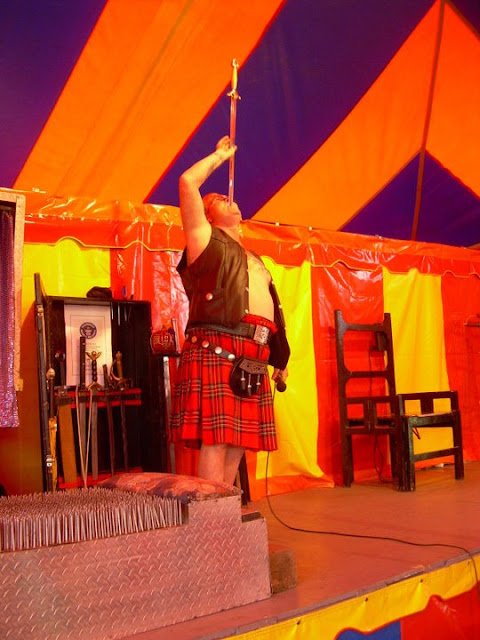
John "Red" Lawrence Stuart demonstrates sword swallowing with a Tai Chi sword
In addition to swallowing swords, Red performed the act known as the Human Blockhead, in which a nail or other object is driven deep into the nasal cavity. It is a relatively recent addition to the sideshow repertoire, developed in the mid-twentieth century by the legendary Melvin Burkhardt. First he inserted an extra-large nail, and then a screwdriver - because, he said, people had always told him he had a screw loose.

Red says his friends call him "Screwy Louie" - here with a nasally inserted screwdriver
Red has an enormous collections of things that he swallows - broadswords, car axles, and even a lightsaber!

The Force is strong with this one: Red swallows a lightsaber
After I stayed through several rotations (or "grinds") of the performance, I turned my attention to the audience. Both adults and children alternated looks of awe, dismay, and delight at what they saw. I don't think anyone walked away having not been entertained.

The audience was, at times, fascinated, aghast, and terrified by what they saw
Keep in mind: these are not tricks. They are not illusions. The bed of nails is a bed of nails. Cris really did light a torch with a spark from her fingertip. Sunshine really did "eat" the fire, closing her mouth around the flaming torch to snuff out the flame, at times even transferring flames (and fuel) to her tongue and her fingers. Red really did swallow swords - no roll-ups or fake blades here - and pound nails into his sinuses. These are all real acts, and dangerous ones at that: the bed of nails is relatively safe, and once you know how it's done, the "Human Blockhead" is as safe as, well, sticking something in your nose. But sword swallowing is dangerous - even trained professionals can and have been seriously injured doing it. And fire eating involves exposing the mucous membranes of your mouth and tongue to toxic, easily-absorbed fuel - fire eaters can only do the bit for so long before they have to take some time off to let their livers regenerate.

I stayed at the sideshow for hours. I had arrived in time to see the last performance before their dinner break, and so I got to hang out with John "Red" Lawrence Stuart backstage - which consisted of a hidden part of the tent containing a row of fold-up chairs, a small table, and, incongruously, a laptop computer with a WiFi connection. ("After five gigs of downloading in a month, they downgrade you to DSL speed," John grumbled - a sentence which probably would not have been uttered behind the scenes at a sideshow until fairly recently.) After Tommy Breen started his bally again, I went back through the main entrance and watched the acts perform over and over.

I was just about ready to leave and I got a semi-expected treat: there, in the crowd, was the legendary Harley Newman, who Red had hoped to see during his time in the area. Harley spotted me, and as the crowd made their way into the "Dr. Frankenstein" blow-off - an extra act with separate admission, not included in the price of the sideshow - we got a chance to speak. I then took my leave of the sideshow, my first sideshow ever, and started the long trek back to my car.

Leaving the Fair

And now The World of Wonders Sideshow has pulled up stakes and moved west, to a carnival just outside of Pittsburgh. After that they will be in Maryland, and then Ohio. I wish them safe travels, good crowds, fair weather, and hope to see them again someday!

Tuesday, July 06, 2010

Damn, I used to be able to write

I bought dental floss today. Fifty-five yards for eighty-eight cents. Dental floss, it seems to me, is a product subject to massive price inflation and massive size deflation. I knew I'd written about this in the past, so I did a search of Another Monkey for "dental floss." What I found surprised me in two ways:

1. The price of dental floss is the same as it was over two years ago.

2. Damn, I used to be able to write.

I don't know if observation #2 is actually true. I mean, maybe what I was writing twenty-five months ago was crap, as crappy as what I'm writing now. But I've always been plagued by this tendency to envy the quality of my writing in the past. I'm sure in June 2008 I was looking back at stuff I had written in 2006 or 2005 and thinking "Wow, I used to be able to write."

Judge for yourself, if you have the time. Stroll through the archives of yesteryear's posts and see if you don't agree.


When you are done, you may enjoy these images of crepuscular rays, taken at about 8:24 tonight:


Saturday, June 12, 2010

Strange Tales: The Antisun Pillar

Wednesday, June 9, 2010. Sunrise. Partly cloudy.

The rising sun cast sunbeams into the sky. Crepuscular rays, if you want to be technical. More technically: the light from the sun was being reflected off of dust and suspended water droplets and spiderwebs and whatnot in the air, becoming apparent only where clouds blocked the illumination, casting shadows in the sky.

I was heading West, and home. It had been a twelve-hour night, my first back after four days off, and I was glad to be done with it. I could not see the sun rising behind me, but I could see the sunbeams skipping across the sky before me, broken up by the clouds. In some places the beams converged on the antisolar point on the far horizon. It was quite a sight.

I wished I could photograph it. But taking photos while driving a car moving at highway speeds is a dangerous proposition. You had damn well better make sure the picture is worth the risk.

A little past the midway point between work and home, I decided that what I was seeing was worth the risk. I fumbled with my camera phone, held it up to the windshield, and hoped for the best.


For the life of me I don't know what I was seeing. It's hard to see in the picture above, but on the left between the nearer light pole and the distant sign there is a beam of light coming straight out of the Western horizon. It didn't look right; it was thick and non-converging, not like what I would be expecting at the point where crepuscular rays meet at the antisolar point. It looked like a distant region of non-rain bordered by two regions of rain falling straight down through still air. But the clouds didn't look like they were dumping rain.

It stayed ahead of me as I continued West. This picture was taken about a minute after the first, about a mile down the highway, and the pillar is now more obvious, dead center. It looked almost like a sun pillar (as seen here, for example), but white, and broader, and opposite the sun.

So what was it? Minnaert states in Light and Color in the Outdoors that crepuscular rays are actually easier to see near the antisolar point, though in my experience this is not the case - perhaps the nature of the atmosphere has subtly changed since he wrote this, with greater amounts of pollution or even dispersed condensation from the contrails of jet airplanes (which were rare when he wrote the original version of the book in 1954) blocking the undisturbed passage of these rays across the dome of the sky. War this a lone unblocked ray that had passed almost directly overhead and therefore appeared to be coming straight down into the horizon? Was it some antisolar analogue to a sun pillar? Was it just a dry patch between two distant downpours? Or was it something else?

Saturday, April 24, 2010

The golden spiderlings

While mowing the lawn this afternoon I noticed the lid on my composter was askew, despite the paving block I have on top to keep it from blowing off. When I went to adjust it I noticed a spider web on the block and the lid, apparently clogged with pollen. Then I noticed that the pollen was moving. I went back in the house and grabbed my camera.

The things that I thought were grains of pollen were actually baby spiders, about a millimeter and a half long. Each was golden yellow with a black spot on the abdomen, the rear section.


On closer inspection of the photos, the black spots appear to be spinnerets, and the spiders' eyes appear to be red - some of them, anyway.


I don't know what variety of spider these spiderlings will grow into. Most of them are fated not to grow up at all. Life is harsh for little spiderlings.