Showing posts with label Theater. Show all posts

Saturday, June 23, 2018

Shakespeare in NEPA

I have a friend with whom I have a sort of standing date: every chance we get, we will see any local performances of Shakespeare's plays. We've seen Macbeth, The Merchant of Venice, and As You Like It in Bloomsburg, Twelfth Night at Luzerne County Community College in Nanticoke, A Midsummer Night's Dream at King's College in Wilkes-Barre, versions of Romeo and Juliet at Bucknell University in Lewisburg (in a gangster setting) and in Bloomsburg (purportedly in an Occupy Wall Street setting, though the two sides more closely resembled Hillary Clinton's "establishment" camp and Bernie Sanders' "progressive" camp,) and versions of Hamlet in Scranton performed by the New Vintage Ensemble and again at King's College (in a World War II setting) in Wilkes-Barre. (I also managed to see The Tempest at King's College by myself, due to a scheduling mix-up, and we went to see a movie theater presentation of Henry IV Part 2 at...I don't really remember where we saw it, but it was recorded at the Shakespeare's Globe, the reconstruction of the Globe Theater in London.)

We recently heard of yet another upcoming performance of Hamlet, but agreed that we were all Hamletted out for the time being. However there are some other options available. My friend sent me this notification a while back:
Gaslight Theatre Company is proud to present William Shakespeare’s The Taming of the Shrew, directed by Brandi George and David Reynolds, June 22-24 and 29-30 at its theatre in the East End Centre in Wilkes-Barre...Performances will be held June 22, 23, 29, and 30 at 8 p.m. and June 24 at 3 p.m. Tickets ($15 for adults and $12 for students, seniors, and veterans) will go on sale on June 8 and can be purchased online at www.ticketfly.com or at the door (please note tickets are not available by phone). Advanced purchases are highly recommended as seating is general admission and limited. The Box Office will open one hour prior to performances.
Then there is this from the Scranton Shakespeare Festival:
The Scranton Shakespeare Festival (SSF) announces its seventh season - an ambitious program featuring two Shakespeare comedies, two musicals, a new devised work, and its annual Youth Theatre Lab piece. Audiences will have the opportunity to catch all the shows in repertory during the festival's signature last weekend, July 27 - 29, 2018. 
For its seventh year, the Scranton Shakespeare Festival will present "How To Succeed in Business Without Really Trying," June 28th through July 1st, and one last time July 27th. Directed by Bobby Temple, the musical will be performed at The Marketplace at Steamtown, continuing the festival's exploration of site-specific theatre, a nod to last year's "Damn Yankees" at PNC Field. 
Randolph Curtis Rand returns to the festival to direct an abridged, four-person version of Shakespeare's "Tempest," double-billed with Brenna Geffers' devised work "Sycorax," specially commissioned by the festival and inspired by a character briefly mentioned in "Tempest." "Tempest/Sycorax" will go on July 6th through July 8th, and July 28th at Scranton Prep. 
"As You Like It," directed by festival newcomer Emma Rosa Went, will go up the following weekend, July 13th through July 15th, as well as July 29th, at Scranton Prep. 
The festival's second musical, "Footloose," directed by Artistic Director Michael Bradshaw Flynn, will perform July 19th through July 22nd, and July 29th, at Scranton Prep. 
The Youth Theatre Lab is set to perform its original adaptation of "Hansel & Gretel" July 7th, 14th and 21st, at Scranton Prep. 
As in previous years, the Scranton Shakespeare Festival continues to push boundaries and expand its reach, exploring a variety of relevant themes and echoing national conversations on challenging the status quo and the youth movement sweeping the country. 
The Scranton Shakespeare Festival is a not-for-profit, government-recognized 501 (c)3 organization. Founded by a board of local community members and theatre professionals who hail from Northeastern Pennsylvania region, the Scranton Shakespeare Festival is now in its seventh season of professional theatre that is free to the public. SSF is made possible by the generosity of local businesses and institutions, the support of grants of both state and national standing, the dedication of our talented company of actors and technicians reigning from Northeast Pennsylvania, New York City, Philadelphia, and beyond, but most importantly through the patronage and donations of our community.
There is also a single Shakespeare in the Park performance of Macbeth on Saturday, June 23 at Riverside Park in Tunkhannock at 7:00 PM.

So, we have options when in comes to Shakespeare in Northeastern Pennsylvania this Summer!

Sunday, February 07, 2016

Shakespearean January

A friend and I have been to numerous plays and other events together over the last - geez - ten years. (Well, nine years and five months, but still, that can't be right, can it?) The last thing we went to together was A Midsummer Night's Dream at King's College in Wilkes-Barre in April 2014. In January of this year we made up for that by going to two plays by Shakespeare.

Image from The New Vintage Ensemble Facebook page.

The first was Hamlet, presented by The New Vintage Ensemble at the Scranton Cultural Center. We saw the final performance of the run on the evening of January 16. It was an unusual experience for me, since I knew several of the actors personally; in a way it reminded me of watching my friends appear in plays in college. Conor O'Brien, former proprietor of The Vintage Theater, played the title role, while blogger and NEPA BlogCon co-organizer Mandy Boyle Pennington (who I first met at an event at The Vintage Theater) portrayed the First Player, Osric, and Francisco (the first character to appear in the play). Simone Daniel, who I met several times at The Vintage, took on the role of Horatio, Hamlet's best friend and confidante.

This was the first outing for The New Vintage Ensemble. The story unfolded on a spare stage; costumes ranged from simple to surrealistic. Hamlet runs over four hours when presented in full, but even this somewhat abbreviated version ran close to three. While the performance started off slowly, the action of the story quickly took hold and carried the characters off to their sundry dismal fates. Conor O'Brien made a fine Hamlet, more cunning and clever than the indecisive semi-madman he is usually portrayed. Hamlet was given the line regarding the fates of his old friends Rosencrantz and Guildenstern, a statement usually delivered by the late-arriving Ambassador from England, whose role - like that of Fortinbras, the Norwegian prince who claims the Danish crown for himself (since no one else is using it) at the end of the play - was eliminated.

On January 30 we went to see the Bloomsburg Theatre Ensemble's presentation of Romeo and Juliet. We have actually seen a production of Romeo and Juliet previously, in February 2011 at the Weis Center for the Performing Arts at Bucknell University. In that earlier production the action was translated into a conflict between competing early 20th-century organized crime families. This production also brought the action into a more modern setting, one that is recent history now, but was actually an event whose beginning was still seven months in the future when we saw the Bucknell version: the "Occupy" movement of late 2011.

We have seen several performances by the BTE together over the years, including Macbeth (2011), Flood Stories Too (2013), As You Like It (2013), and The Merchant of Venice (2013.) While neither of us know any of the performers personally, we feel like we know the ensemble members from seeing them play different roles in different plays.

Even the theater itself was a character in this production: Upon arriving at the doors you immediately saw notices from the management advising that the pitching of tents, setting up campsites, or any similar activity was strictly prohibited. Going through the doors you entered into a lobby under occupation, with hand-lettered cardboard signs dotted around the tents that filled much of the space. The performance space was immersive, with sets spilling off the stage, the walls covered with more protest signs (incongruously including the hand-drawn logos of the play's corporate sponsors), spectators seated on the stage with the actors, and actors performing throughout the audience, on ladders, and on the catwalk over the stage. Characters wore the garish fashions of four and a half years ago - the Montagues now being protesters in the Occupy movement, and the Capulets representing the Establishment (embodied primarily by ambitious political candidate Lady Capulet.) The Prince, who is fed up with the violence between the two factions, has been distributed over several masked police officers in riot gear, his proclamations announced through a bullhorn. Invitations are written on iPads, messages are sent by text, and Romeo's misplaced cell phone spells disaster

This was a very engaging and energetic production, bringing new life to a play that for many has been done to death from high school on. Strangely enough, while the "Occupy" theme of the play seemed remote, almost more like something from the early 1970's than the early 2010's, the positioning of Lady Capulet as an ambitious politician, particularly one in conflict with a movement composed of idealistic youths, opened the possibility of another interpretation. The story was basically one step away from being in the here and now, portraying a conflict between the "establishment" supporters of Hillary Clinton and the "progressive" supporters of Bernie Sanders.

One missed opportunity was the complexity of the character of Mercutio. Mercutio was, as usual, portrayed as the closest friend of Romeo. Yet Mercutio is neither Montague nor Capulet; he is instead a relative of the Prince, and as such can move relatively freely among both sides of the conflict. He can also defy the Prince's orders with some degree of impunity. In the context of this production, Mercutio, excellently and playfully played here, is solidly with the protesters. But his (in this case, her) connection to the Prince in the original would translate into a connection to the riot-geared police in this version - an interesting complication that was not touched upon.

Perhaps the "Occupy" theme was carried a bit too far. There were no programs or playbills provided with cast lists or production notes - nor, as far as I can tell, is this information available at any official site. Instead, audience members were provided with double-sided hand-drawn photocopied sheets, with instructions given by a member of the cast on how to fold them into a matchbook-sized booklet. Unfortunately, this booklet contains very little useful information, and is pretty much just a souvenir of the play. (I was able to glean a partial cast list from several newspaper reviews published online.)

As the actors mingled with the audience before the play I noticed one young lady in a long green dress, and wondered what role she would perform. When the play began she took her place on a riser above the main stage. While she did speak some lines at the beginning of the play - chiding the minions of the Montagues and Capulets squabbling in the street, just before the forces of the Prince show up - it turned out that her role was to provide the music for the play, singing, playing guitar and keyboard, as well as both body and cardboard box percussion. Her voice had a lush, rich, haunting quality to it that reminded me most of Colbie Caillat. (Others have compared her to Norah Jones.) Later in the play the actors who had portrayed the by-then-deceased Mercutio, Tybalt, and a few others joined their voices to hers on her song "Man in Black" as the story spiraled to a tragic conclusion. Her musicianship was remarkable almost to the point of being distracting: I realized I was paying more attention to her singing than I was to the action of the play.

Image from CDBaby.com

Her name, I learned after the show, is Sydney Panikkar, and she is just fifteen years old - remarkably young, it seemed to me, to be so deeply involved in this production, though I realized later how ironic this is, since the titular characters of the story are only thirteen or fourteen years old. She does not have a website for her music yet, though she does have an online presence through Twitter and Instagram, as well as a YouTube page. She also has her music available for sale at the CDBaby.com website, where you can download one song at a time or her entire album, "The Perfection in Imperfection."  (Per the site it is available as a download only, but her representatives had physical copies for sale after the play.) She is a talented and promising young musician, and I hope we will be hearing more from her in the future.

Sunday, October 06, 2013

REVIEW: The Merchant of Venice by the Bloomsburg Theatre Ensemble


One-word, spoiler-free review: Brutal.

A longer review follows, with some spoilers if, like me, you don't actually know anything about this play other than the name "Shylock" and the phrase "a pound of flesh."

Synopsis (full of SPOILERS): 

Young Bassanio (Aaron White) has a problem. He wishes to travel from Venice to distant Belmont to pursue the hand of Portia (Cassandra Pisieczko), a young heiress whose late father decreed shall have her future husband determined through a test: suitors must choose from one of three boxes, gold, silver, or lead, each with its own warning. One of them contains an image of Portia, and the man who chooses that box will win her hand in marriage along with her great inheritance, but selecting either of the other two condemns its chooser to be forever alone. But Bassanio lacks the funds to finance such a venture, so he seeks a loan from his friend Antonio (James Goode), the titular Merchant of Venice. Unfortunately Antonio finds himself lacking liquidity, with all of his wealth tied up in three trading vessels off in three distant ports. But, seeing Bassanio's need, he agrees to seek a loan from Shylock (Tom Byrn), a despised Jewish moneylender (who, unlike Antonio, demands interest on the money he lends - a source of conflict between the two.) Bassanio pleads the situation to Shylock, who agrees to a three-month loan to Antonio, who expects to have his trading profits in hand in just two months, allowing him to pay off the loan well before its due date. But Shylock, generally scorned by Venetian society and particularly put upon by Antonio, stipulates a unique penalty clause: should Antonio default on the loan, he shall be bound to pay a penalty of a pound of his own flesh. After some trepidation, Antonio agrees freely.

Meanwhile, Bassanio's friend Lorenzo is scheming to run off with Shylock's lovely daughter Jessica (Sophie Schulman) after she renounces her religion and converts to Christianity, all while Shylock is in negotiations with Antonio. Bassanio and his sidekick Gratiano (Daniel Roth) travel to Belmont, where most of Portia's suitors have either failed or given up the game. A Moorish prince only recently arrived (Daniel Roth again) is the last holdout, but he chooses poorly and is sent back to his own land empty-handed and with an oath to forevermore remain single. Portia celebrates his failure with these lines:

A gentle riddance. Draw the curtains, go.
Let all of his complexion choose me so.

Shylock is enraged and heartbroken at his daughter's betrayal, and even more so with the wanton thefts of his cash and jewels that she used to finance her flight with Lorenzo. Shylock's friend (and fellow Jew) Tubal (still yet again Daniel Roth) brings more bad news: Antonio's ships have all met separate disasters, and he is now unable to repay the loan. While Shylock at first laments the loss, his rage rallies him when he realizes that he will be able to seek his revenge against society in general and his longtime abuser Antonio in particular by keeping to the letter of his agreement and extracting his pound of flesh.

Meanwhile, back in Belmont, Bassanio has wooed Portia but now faces the test of the three boxes. Carefully considering the symbolism of each box's materials as well as the meanings of the attached messages, he successfully chooses the right box and wins Portia's hand and all that comes with it - including a ring presented by Portia that symbolizes Bassanio's commitment to her, given on the condition that he will never remove, sell, or lose it. Gratiano reveals that they shall have a double marriage, as he has successfully wooed Portia's friend Nerissa. But their joy is short-lived as the fugitives Lorenzo and Jessica arrive in Belmont with word of the loss of Antonio's trading fleet and his ability to repay his loan, and Shylock's determination to have his pound of flesh. Bassanio is distraught, as he is unable to repay the loan himself, but Portia points out that she is the heir to immense fortune, and upon their marriage he will be able to repay Shylock many times over.

Bassanio and Gratiano return to Venice to seek Shylock's mercy and repay his loan, while Lorenzo and Jessica stay behind at Portia's. But Shylock, wounded and angry, will have none of it, and demands that the letter of the deal be observed - or Venice itself will lose its reputation among the traders who use the city as a hub. The Duke of Venice (Samantha Norton) concedes the validity of Shylock's position, but seeks his mercy - telling him that all the world is anticipating a last-second change of heart. A lawyer (or judge, he is referred to as both) and his assistant arrive to work Antonio's defense, but Antonio has resigned himself to keeping his grisly deal, and to the death that will inevitably result from it. Shylock, after several aborted attempts, steels his determination to remove the pound of flesh - or at the very least, to kill his debtor and longtime abuser. But the lawyer - actually Portia in disguise, secretly come to Venice with Nerissa - has one last ploy: while Shylock is owed his pound of flesh, nowhere is the deal is it stipulated that he may draw one drop of "Christian" blood, and he will be sternly punished if he does. Stymied by the impossibility of collecting that which he is due without drawing blood, Shylock regretfully concedes that he has lost, and agrees to the payment from Bassanio as promised, or at the very least to the repayment of his principal. But the false lawyer has one more card to play: as an "alien" who has threatened the life of a citizen, Shylock is subject to the loss of his property: half to the injured citizen, half to the state. Shylock pleads that the loss of his property will render him penniless and unable to conduct business. Antonio calls on the Duke's mercy, allowing Shylock to keep his property on the condition that he convert immediately to Christianity, and pledge his fortune to his "son" Lorenzo and his daughter Jessica. In agony, Shylock agrees.

The false lawyer and her partner are not done yet, as "he" demands one thing only from Antonio as payment for winning his case and his life: the ring worn by Bassanio, the one he had pledged to never remove, sell, or lose. Bassanio refuses, to Portia's delight, but after Portia and Nerissa leave, Antonio convinces Bassanio to relinquish the ring. Gratiano is tasked with delivering the ring to the lawyer, and he catches up to Portia and Nerissa (still in disguise) as they plan their return to Belmont. Portia is devastated at Bassanio's betrayal of his oath, and Nerissa decides to try to separate her own husband from his ring.

Portia and Nerissa hurry home to Belmont, where they are reunited with Lorenzo and Jessica. Bassanio and Gratiano follow soon after, whereupon they are taken to task for the removal of their rings. Portia supplies a "new" ring to Bassanio, who is mystified to see that it is the same ring he had before. Portia reveals that she got it from a lawyer, with whom she had slept the night before. Nerissa joins in the fun by revealing that she has been sleeping with the lawyer's assistant. Gradually Bassiano realizes that the lawyer and his assistant were Portia and Nerissa in disguise. Portia then supplies good news for all: to Antonio, the fact that his trading ships have returned successfully, and were never sunk at all, while to Lorenzo she reveals his good fortune in becoming Shylock's heir - and Shylock's conversion to Christianity. The play ends, and everybody's happy.

Only that's not what happened. At all.

REVIEW:

The Merchant of Venice is a difficult play to approach, as director Andrew Hubatsek admits. Racism and anti-semitism fill the work, even in this pared-down version. As his director's note points out, early versions of the play presented Shylock as a pure villain, while more modern versions emphasized the wrongs done to him, and even the villainy of those around him, the other characters in the play. This is a "Comedy" in the strict sense that none of the main characters wind up dead (which is what distinguishes Shakespeare's "Tragedies.") But Shylock's arc is in no way a happy one. In Shakespeare's day his ending would be seen as worthy of rejoicing; having accepted Christ, even under duress, he is now no longer subject to the just punishment seen as coming to all Jews. A similar happy fate awaits his daughter Jessica, even though she is still referred to as an "infidel" after her conversion. Tom Byrn imbues his Shylock with rage, righteous rage - rising and bubbling over in the public places of Venice as he confronts Salanio (the ever-flexible Richard Cannaday, in one of three distinct roles) with the classic soliloquy:

Hath not a Jew eyes? hath not a Jew hands, organs,
dimensions, senses, affections, passions? fed with
the same food, hurt with the same weapons, subject
to the same diseases, healed by the same means,
warmed and cooled by the same winter and summer, as
a Christian is? If you prick us, do we not bleed?
if you tickle us, do we not laugh? if you poison
us, do we not die? and if you wrong us, shall we not
revenge?

In the courtroom, demanding what he is owed from Antonio, he pastes a veneer of calmness over his rage, coolly relying on legalities to make his case. When those same legal niceties are turned against him he collapses like a man with his legs cut off. But Portia, cruel Portia, is not content with defeating Shylock. She must destroy him as well. In short order he has lost his daughter, his debt, and his case. Now he faces a choice: lose his property and his livelihood, or lose his religion and his self. Broken, defeated, and destroyed, he chooses the latter, With trembling hands Antonio removes a crucifix on a chain that had hung around his own neck (and had been thrown aside by Shylock as he prepared to take his pound of flesh) and places it around the neck of Shylock, who has removed his skullcap as a sign of renouncing his religion.

In the final scene the characters all react with growing joy at the news of their good fortunes - all except Jessica, whose face and attitude reflect a dawning horror. She has betrayed her father and her religion. She has abandoned them both, has stolen his money and prodigally squandered it, has fueled his rage and helped bring about his misfortune and his fate. As the other characters exit the stage, she stands alone in the gathering darkness and sings a mournful Jewish song; her father, bare-headed, appears in the shadows and slouches despondently. The lights go down as she finishes the song, leaving the stage in darkness.

Pretty brutal for a comedy.

I've never seen The Merchant of Venice before, nor was I familiar with the particulars other than the character of Shylock the moneylender and the details of the "pound of flesh" contract (which I picked up either from "Se7en" or the absolutely brilliant 1973 satire "Theatre of Blood" which, if you haven't seen, you must see!), so I didn't know what to expect, nor did I know how various bits would turn out. I even forgot whether this was a Comedy or Tragedy, so I was expecting the body count to begin at any moment.The acting and staging is superb, and Andrew Hubatsek (whom I have seen play Macbeth, Touchstone the Fool in As You Like It, and several other parts) directed beautifully, and was also responsible for the adaptation. The play runs through October 20. Details are available at the Bloomsburg Theater Ensemble site.

(The full, unedited text of the play is available here.)

Thursday, June 28, 2012

The Vintage Theater: AWESOMENESS IS COMING

It's a little to early to let the car out of the bag, but let me just say that there are some fundraising events that are coming up on behalf of the new and improved Vintage Theater in Scranton that are just amazing beyond words.  If you live anywhere near Northeastern Pennsylvania, YOU WILL WANT TO BE A PART OF THIS!!!

Details coming July 1!

Thursday, May 24, 2012

Next steps for the Vintage Theater


While it may sound dramatic to declare that "the Vintage Theater in Scranton is closing" (as I did) and to refer to the final First Friday celebration on June 1 as "the Last First Friday" (as I do), the truth, as always, is somewhat more nuanced.

The Vintage Theater is moving out of its current location at 119 Penn Avenue. (This isn't even the original location of the Vintage Theater. I discovered last night that I was correct in believing that it was originally housed in the old Ritz Theater where I used to see dollar movies when I was in college.) But that doesn't mean that the Vintage Theater is going away.

The idea of the Vintage Theater is what's important. It has been a multi-purpose art space where specific events - concerts, art exhibits, poetry readings, plays - brought the people in, and the synergies between the various art forms sharing the same space brought people back. That idea will be maintained, regardless of where the next incarnation of the Vintage Theater sets up shop.

The proprietors of the Vintage Theater are looking for a new home. Something affordable, something within the footprint of Scranton's First Friday celebrations, something accessible, something that is capable of serving the needs of all the different artists who present their creative works within the theater. They have made a list of seventeen different possibilities, and last night an eighteenth was presented - one that no one realized was even on the market.

But they're not rushing into this. They want to do this right. So during the transitional period, we will all have to be patient.

In the meantime, they have needs. Immediate, medium-term, and long-term needs. In the immediate future: they will need to be out of the 119 Penn Avenue location after the June 1 First Friday celebrations. That means that by June 1 they need to be 99% moved out. So in addition to being patient, anyone who really cares about the Vintage Theater should be prepared to lend a hand in some way - now, tomorrow, during the transition period, or in perpetuity.


The immediate needs:

- A plumber capable of doing the disconnection work on a very expensive and delicate European espresso/latte machine. I doubt that my own ham-fisted plumbing skills are up to the task.

- A carpenter with a portable saw to disassemble the very large and heavy countertops.

- An electrician to help with removal of light fixtures.

- General moving help to get stuff off the premises. This includes vehicles for hauling things away.

- Storage space for stuff that's been removed from the premises.

To reduce the tonnage of stuff that needs to be moved there will be a rummage sale on Monday, May 28th starting at noon. Books, chairs, art materials - almost anything that's still around on Monday will be up for sale. (So, FYI, if you're reading this and happen to have stuff that you kind-of left sitting around the Vintage Theater, you might want to reclaim it before Monday.)

After the hard (and frankly, heartbreaking) work of vacating the 119 Penn Avenue location is over, then the next stages will continue in earnest: identifying the needs of the next incarnation of the Vintage Theater, and making it a reality. And after that happens will come the really hard point: doing what needs to be done to keep the theater going.

The Vintage Theater is closing. The Vintage Theater will be back.

Tuesday, June 23, 2009

Next research obsession: The Threepenny Opera

This is all Alan Moore's fault. And Kevin O'Neill. And Jess Nevins. And Nellie McKay.

It really started with Nellie McKay, who I had never heard of before her appearance on the radio program Fresh Air back on November 21, 2007. If you don't know who she is, do yourself a favor and follow the link. Scroll halfway down the page and click on "Hear the Original 'Fresh Air' Interview and Performance" and be amazed at her remarkable voice, wit, and talent. She played Polly Peachum in the 2006 production of Bertolt Brecht's "The Threepenny Opera", and sang the song "Pirate Jenny" on the show.

This really served as my introduction to the play, which I only knew previously through the song "Mack the Knife". But I had warning well in advance that the next chapter of Alan Moore and Kevin O'Neill's "League of Extraordinary Gentlemen" series, "Century: 1910", would be heavily intertwined with The Threepenny Opera. Last week I picked it up, and did my first read-through in little more than a day.

Anyone familiar with the work of Alan Moore, and the Moore/O'Neill "League" stories in particular, knows that these stories deserve and demand close reading. Jess Nevins has done all the heavy lifting by researching and creating heavily detailed guidebooks for each of the previous Volumes as well as The Black Dossier, and has put one together for Century: 1910 as well. (Note: The comment about the source for "Doctor Van Helsing," page 18 panel 3, is a joke. Jess told me so.)

There are details in the book that Jess hasn't touched on, yet - the noose from which Macheath is to hang, with a metal ring looped around the rope instead of the traditional knots, is of a design I've never seen before. I'm not familiar with the music from The Threepenny Opera, aside from "Pirate Jenny" (which figures significantly in the book) and "Mack the Knife." There's so much more to be extracted from this book, but it will take time, and study. I'm not sure how long it will take to find the time, but I will, somehow.

Wednesday, February 18, 2009

Sweeney Todd review

I saw Sweeney Todd this past Sunday, February 15, 2009 at the Scranton Cultural Center, courtesy of a friend. Aside from a quick read-through of the Wikipedia entry this was my first exposure to the story, not counting fleeting references in popular culture (the elephantine aliens in Larry Niven and Jerry Pournelle's Footfall catch a bit of it while scanning TV broadcasts from Earth) and my confusing childhood ownership of a die-cast Corgi Rockets Todd Sweeney race car.

I enjoy going to the theater to see live performances, even ballet. (Real men can admit they enjoy ballet. I like quiche, too. You wanna make something of it?) To know that every moment of practice and preparation and training has led to this moment on stage, right now, which passes before it can even be comprehended and makes way for the next. What can the performer do with that moment? What framework have the writer, composer, director, and the history and tradition of the particular piece provided?

I've seen a few live performances in my life. The ballets Copellia and The Nutcracker (several different stagings, never the same one twice), The Fantasticks and Bus Stop and The House of Blue Leaves and The Zoo Story and Anything Goes in college, She Stoops to Conquer and Lysistrata at my alma mater a few years back, Les Misérables in London, RENT in Scranton, Twelfth Night at the local community college, STOMP many years ago, and a few others. Sweeney Todd is just the latest.

The other productions had one or more characteristics in common: Music that got under your skin and stayed with you ("Look Down" and "Who Am I?" and "One Day More" from Les Mis, "Try to Remember" and "It Depends on What You Pay" - which I remember as "Rape Song" - from The Fantasticks); characters who you could relate to, or at least care about; stories that carried you along, even if you knew where they were going already; a message, a moral, a theme...something.

Sweeney Todd is different.

For the most part the characters are one-dimensional. Sweeney Todd is an angry spirit of vengeance from the moment he rises from his own coffin; his anger grows, and eventually blinds him entirely, threatening to destroy everyone he once held dear. Mrs. Lovett is a monster with a few tinges of humanity and a couple of laugh lines; like the Thénardiers in Les Mis, she is such a scene-chewing character that it is impossible not to get a kick out of her. Anthony, who resembles in many ways Antonio from Twelfth Night, is an earnest but dopey soul, befuddled by infatuation with the similarly dopey and love-struck Johanna, Sweeney Todd's stolen daughter and the ward and love interest of the monstrous Judge Turpin, who exiled Sweeney Todd in his previous identity of Benjamin Barker in a plot to have Barker's beloved wife for himself. The Beggar Woman is tragic on multiple levels, Pirelli is little more than an accent, Jonas Fogg is a sub-monster with precious little to say or do, the Beadle is more a clown and stooge than villain. Tobias, Pirelli's (and later Mrs. Lovett's) half-witted assistant, is the only character with a bit of depth; he wanders through the story and pieces together what is happening, losing what little he has of a mind in the process. It is through his somewhat deranged voice that this tale is told, at least initially.

There is no character in this cast that really makes you care about them. Sweeney Todd got screwed; yes, that's sad, but, you know, if everyone who had crap happen to them became a serial killer, there would be a lot fewer people around to seek revenge on. Mrs. Lovett's moments of humanity displayed in her reverie "By the Sea" are offset by frequent reminders that she is as monstrous a villain as the Judge. The Old Beggar Woman and Johanna are tragic, but ultimately annoying. Anthony almost elicits sympathy in his quest to free Johanna from her confinement and run off with her. Tobias - well, yes, what happens to him in the end is more tragic than all those who get their throats neatly slashed, which is nearly every other character in the story, but his dim-wittedness makes it hard to relate to him.

No performer really thrilled or disappointed me. All were quite up to playing their roles. Merrit David James's Sweeney Todd was angry from beginning to end. Carrie Cimma played Mrs. Lovett with lusty gusto. Standbys Andrew Crowe and Marita Stryker (who has a beautiful singing voice) played the young lovers Anthony and Johanna quite well. Patty Lohr's Old Beggar Woman flicked easily through all of the derangements of her character, from a pathetic poor thing to a lewd and vulgar creature of the streets to a moment of clarity in "City on Fire." Ruthie Ann Miles's Pirelli was good for a laugh, but seemed to be more matter-of-fact than menacing in her confrontation with Todd. Judge Turpin, as played by David Alan Marshall, was appropriately detestable, while Matt Cusack's Jonas Fogg had a bit of a Mad Scientist bent. (Maybe it was the glasses and lab coat.) The Beadle was played by Bob Bohan as a buffoon, in a characterization that clashed somewhat with the more spare and severe performances around him. Chris Marchant's Tobias shuffled and cringed and was pathetic, tragic, abused, and earnest, somewhat reminiscent of poor Smike from Nicholas Nickelby.

Staging was consistent with the 2004 revival version, with the actors also serving as the orchestra. Murders were accompanied by an ear-splitting steam whistle, a change in the lighting, a momentary tabelau freeze, and a costume change as the victim donned a blood-stained white smock. Impending deaths were often foreshadowed as other characters approached the doomed one while carrying the smock.

While the music of Sweeney Todd has received high praise from others, I found it mostly forgettable. Only "The Ballad of Sweeney Todd" stuck with me as I left the theater. "A Little Priest" made me want to stand up and yell at someone, or at least throttle Stephen Sondheim.* "By the Sea" was alternately funny, touching, and horrific.

I am very grateful to my friend for the opportunity to see this performance. I would be very interested in hearing from others who have seen the original, the revival, and the current tour, to see how their experiences compare to my own.


One quibble: Sweeney Todd sings of his silver-handled razor. The image on the cover of the playbill shows a razor with a handle that appears to be walnut or some other wood.

*This song violates all of John Cleese's rules of comedy:
1. No puns.
2. No puns.
3. NO PUNS!

Sunday, February 15, 2009

There will be blood, and pies

I'm off to see Sweeney Todd at the Scranton Cultural Center, courtesy of a friend. I'll let you (and the performers!) know how it goes.

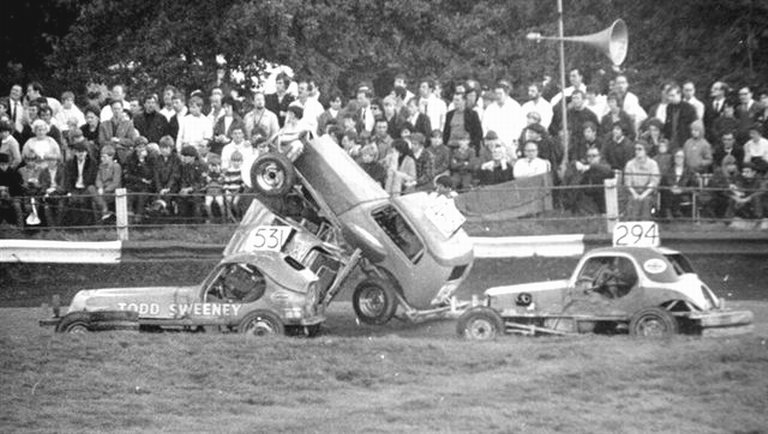
Not to be confused with Todd Sweeney, a British racer from the 1950's. I had the Corgi Rockets Todd Sweeney car when I was a kid, though I don't remember it looking like this.

Thursday, April 03, 2008

Review of the National Players' production of Twelfth Night

I had the pleasure of seeing the National Players perform Shakespeare's Twelfth Night at Luzerne County Community College in Nanticoke on April 1, 2008. Jennifer gives an excellent encapsulation of the play, so I won't go into the particulars of the story here. (I brushed up on the play - to which my only exposure was the final scene of Shakespeare in Love - by reviewing the Wikipedia entry. Not a perfect or even a good solution, but in retrospect the entry seems to have been fairly accurate.)

The play was staged in a lecture hall in the school's Educational Conference Center. The stage entrances doubled as the exits to the room, and were blocked off by black curtains. As the audience entered the room they walked past a table filled with the makeshift props that would be used in the play. The cast, who had mingled with the audience in the hallway outside the lecture hall before the room was opened up, took the stage in darkness; when the lights came up, they were shown to be dressed identically in white T-shirts and khakis, and looked about themselves bewilderedly. A conveniently located garment rack provided costumes, which to my eyes appeared to be primarily in a late eighteenth-century style. Some were complete and elaborate, some were simple, and some were, as with the props, decidedly makeshift - intentionally so, as Jennifer explains, in keeping with the theme of the play.

More than costumes and props, it is the cast that makes the play, and this cast did a wonderful job of bringing Shakespeare to a modern audience.

Orsino, played by Bill Army, is something of a cipher: a lovestruck nobleman who never seems to rise above a passionless, almost emotionless equanimity - save for a shockingly vicious decision at the end of the play that is expressed with such casual coolness that it comes across as all the more horrifying.

Sarah M. Johnson performed the role of Viola/Cesario. She quite convincingly inhabited the role of the young woman in disguise as a young man, and hit all of the right notes for presenting an attitude and bearing that accidentally won the heart of the mourning Olivia.

Madeleine Russell instilled her Olivia with a snideness that brought new edge to Shakespeare's words. Her Olivia seemed as much in isolation as a result of being disgusted with the male suitors who sought her hand as for her stated reason of being in mourning for the passing of her brother. Her icy exterior was melted by her admiration, and later adoration, of the dashing, relentless, and fearless Cesario - Viola in disguise, acting only to ply Orsinio's troth in his stead.

The night was stolen by the actors portraying the secondary characters. Ryan Mitchell as the drunken and boisterous Sir Toby Belch, Olivia's uncle, and David Frankenberger, Jr. as the braggart, dandy and fool Sir Andrew Aguecheek, a would-be suitor of Olivia (or any other woman, for that matter) who is being depleted of funds by the libertine Belch, gave performances that were not simply over the top, but went down the side, around the back, and back under the bottom again. When the two jolly topers meet with Feste the Fool (or Clown, as he is listed in this version of the play), Shakespeare writes the scene thusly:

SIR ANDREW
Excellent! why, this is the best fooling, when all
is done. Now, a song.

SIR TOBY BELCH
Come on; there is sixpence for you: let's have a song.

SIR ANDREW
There's a testril of me too: if one knight give a--

Clown
Would you have a love-song, or a song of good life?

SIR TOBY BELCH
A love-song, a love-song.

SIR ANDREW
Ay, ay: I care not for good life.


Mitchell delivered the line as "A LOVE SONG! A LOVE SONG!!!!" with Toby Belch in such a drunken furor that he seemed about ready to knock Sir Andrew Aguecheek's cockeyed hat right off his head. Jeremy Larson's Feste, who is less of a fool than many of the characters in the story, was played to fine effect, invigorated by Larson' skills with the guitar and vocals.

Since this trio lacked sufficient wit to do much more than engage in songfests and drunken revelry, wit was supplied to them from without by the beautiful and cunning Maria, one of Olivia's women, played by Kieran Welsh-Phillips (who also doubles as the tour's Music Director.)

Maria hatches a plot to undo Olivia's Puritanical steward, Malvolio, played by Cory Cunningham. Cunningham's Malvolio is every bit as preposterously wonderful as Mitchell's Toby Belch or Frankenberger's Andrew Aguecheek, though his performance is all the more remarkable because of the level of restraint his character must display - at first. The revelation of the full extent of his "cross-gartered" state made me wonder where he got a pair of breakaway pantaloons.

Rounding out the cast are Benjamin S. Kingsland, who played Orsinio's man Curio and various other roles; Branda Lock as Olivia's other Lady in Waiting, devoid of lines but not of charm; Scott Zenreich as Viola's identical fraternal twin Sebastian - both of these actors resembled each other closely enough to make this conceit believable; and Wilkes University alumnus Dan Van Why as the hapless and loyal Antonio, who steals much of the final scene with his confused and bewildered expressions wordlessly delivered while he is tied to a chair. When he finally breaks his silence by posing this question to Sebastian and his lookalike sister Viola...

How have you made division of yourself?

...his delivery darn near brought down the house.

As we exited the lecture hall I commented to my friend that this seemed like a lot of effort to put into a single performance. But it was true, and many of this tour's performances are one-night stands. To make things even more hectic, the same tour group is also putting on a presentation of Jack London's The Call of the Wild! The remaining schedule:

4/1/08 Nanticoke, PA Twelfth Night
4/4/08 Florence, SC Twelfth Night
4/5/08 Florence, SC Call of the Wild
4/9/08 Columbia, TN Twelfth Night
4/14/08 Yankton, SD Twelfth Night
4/15/08 Yankton, SD Call of the Wild/Twelfth Night
4/19/08 Cheboygan, MI Call of the Wild
4/22/08 Kirksville, MO Twelfth Night
4/26/08 Sandwich, IL Twelfth Night
4/29/08 Towanda, PA Call of the Wild
5/1/08 Washington, DC Twelfth Night


If you have an opportunity to see this tour, do so! It will be time and money well spent.

Tuesday, April 01, 2008

Touching base

Just got back from seeing Twelfth Night, which was much funnier than I expected. I'll write more on that later. Favorite line: "If you be mad, be gone; if you have reason, be brief."

No time for April Fooling, either. Next April will be too late for the post I have planned, so I may slip it in later as a general parody.

Missed Barack Obama - and Hillary Clinton, who was definitely not the main attraction today, though both were in Wilkes-Barre simultaneously. I was hoping for an account of the Obama show from Gort, but he was unable to attend. I'll check out the site he's directing readers to, though I'd rather have a firsthand account from him! Someone I work with may have gone to see him, though I don't know how much stock I'd put in his report.

I did hear that Obama made at least one gaffe, when he mentioned to the crowd in Wilkes-Barre that he knew how many of them had lost their jobs in the steel mills. Ummm, nope? No steel mills here, at least, nothing major. We do - or did - light and heavy manufacturing. Electronics, TV faceplates, TV picture tubes, chemicals, garment mills, toys, processed food...but no steel. Coal mines, once, many decades ago, but that all ended with the Knox Mine Disaster. The steel mills were down in your last stop, Senator Obama, the Allentown/Bethlehem area. Not here in Northeastern Pennsylvania.

Must get to bed soon so I can be up bright and early to clear a path for a dryer repairman. I hope the dryer is fixable. I don't feel like buying another major appliance. 'Specially since I may be looking at buying a really major appliance if my car turns out to be unable to pass inspection without an unreasonable amount of repairs.

funny pictures
moar funny pictures
Drat! That last LOLCat I made (which was just a recaptioned version of an image someone had previously posted on I Can Has Cheezeburger?, and was a reference to the Andre the Giant Has a Posse / OBEY GIANT street art campaign) hasn't even made it to the voting page, and this one (which I banged out in one minute, again using someone else's image) already has a 4 Cheezeburger rating with 48 votes? Craaaaazy!

Monday, March 31, 2008

Thoughts on the Eve of All Fools

Tomorrow is April Fools' Day. What hijinks will erupt on the Internet this year? And why did Barack Obama choose that day to come to Northeastern Pennsylvania?

Both candidates will actually be in Wilkes-Barre simultaneously tomorrow, unless I'm reading the schedules wrong.

My time online will be limited tomorrow, as I'll be taking in a performance of Twelfth Night at Luzerne County Community College (LCCC, also known as the University of Nanticoke.) Sheesh: Roméo Dallaire last Wednesday at my alma mater, the University of Scranton, Blue Sundaze at King's College last Thursday, now a little Shakespeare at LCCC! I just need to add events at Wilkes, Marywood, Misericordia, Penn State Lehman...wow, we have a lot of colleges hereabouts.

Had a snippet of a dream on Saturday, after nearly eight hours of sleep, and the beginnings of one this morning after six. No walking around in a hypnagogic state today, which is good. If I get to bed soon I may get SEVEN! WHOLE! HOURS! of sleep. We'll see what dreams may come.

Sunday, February 24, 2008

RENT review

I forgot something I learned after writing about seeing Les Miserables in London in March of 2006: actors sometimes Google themselves to see what people are saying about their performances. So with that in mind, I offer this brief (and name-filled) review of RENT.

I saw RENT with a friend at the 2:00 matinee on Saturday, February 23, 2008 at the Scranton Cultural Center (formerly known as the Masonic Temple.) We sat in the third row on the extreme left - close enough to see up the actors' nostrils, though some of our view of the far left of the stage was obscured by a tower of lights and speakers, and at times a light picking out things happening on the far right of the stage shined directly in our eyes. (This is, however, the best place to sit for a closeup view of Maureen's bare butt - portrayed by Christine Dwyer's bare butt - when she drops trou to send a message to Benny the landlord, played by John Watson.)

Briefly put, everything about this production was fantastic, and I regret that this may have been my only opportunity to see the show, since it is closing on Broadway on June 1.

Real standout performances were given by Heinz Winckler as Roger and Kristen-Alexzander Griffith* as Angel. The part of Roger is very vocally demanding, and Winckler was more than equal to the task. Angel is perhaps the most physically demanding role, and Griffith performed fabulously.

Also notable were Anwar F. Robinson as Tom Collins and Jennifer Colby Talton as Mimi. Tom Collins (the only character called by both his first and last names throughout the story) is a character who provides a sort of emotional compass for the story, while the role of Mimi is as vocally demanding as Roger and nearly as physically demanding as Angel. Both Robinson and Talton gave wonderful, memorable performances.

I found the character of Mark, performed by Jed Resnick, to be the weakest link in the chain of RENT. Perhaps the character, who serves as the narrator, is written that way; having never seen any other portrayal, I have nothing to compare this performance to. Resnick's vocal performance was less powerful than those of Winckler and Talton, though his duets were beautiful and richly nuanced throughout the show.

As the story progressed, you really cared about these characters. The death of one of them brought real tears to the eyes of even the biggest and toughest audience members - not because a fictional character had died as the script demanded, but because the portrayal of the character's passing evoked memories many, many deaths that had been experienced in the real world.

It is possible, I suppose, to buy your ticket and go to see a play, or a movie, or a concert, and then walk out of the venue and carry on your life as though nothing had happened. It is a characteristic of a performance that is more than mere entertainment that the experience of what you have witnessed stays with you, and dwells in your head and heart and soul long after the set has been struck and the tour has moved on. RENT is such an experience.

Tonight is the final performance in Scranton. From here the tour moves to Grand Rapids, Michigan on March 4 and 5, and then leaps back East for performances in Baltimore, Maryland on March 7 through 9. (Who the hell came up with that tour schedule? In fact, the schedule gets even crazier from there - two days after Baltimore they're in Tulsa, Oklahoma, on the 11th and 12th, then two locations in Missouri from the 13th through the 16th, then back up to Ohio for a single day, then a week in Ontario, then three days in Tennessee, six in Virginia, then a nice long stay in Florida...really, I get dizzy just looking at that schedule!)

If the RENT tour comes anywhere near your town, I highly recommend going to see it! Tell them that d.b. echo sent you, and you read about it on Another Monkey!

*There was some discussion between us as to whether this was an actor portraying the transvestite Angel, or an actress playing a man who dressed as a woman, or perhaps a transgendered man playing a transvestite. I had hoped that the website listed in the biography section, KristenAlexGriffith.com, might be of some help in clearing this up but unfortunately - and ironically, given the thematic content of this story - this site has been cybersquatted!

Will I?

One song that really hit home in RENT was "Will I?" It is a very simple song - a round, really, consisting of just three lines, overlapped by many voices:

Will I lose my dignity?
Will someone care?
Will I wake tomorrow from this nightmare?

Here it is from the movie version:

This song isn't just about people facing the future of living with AIDS. It applies to us all. As someone who has spent so very much time in nursing homes, hospitals, and the VA, when I hear this song I see my great-aunt, my grandmother, my father, my uncle - all of whom had family and friends who visited them every day - and hundreds and hundreds of others who did not have even that. Unless the way end-of-life care is handled in this world changes, I fear the answers to the three questions are Yes, Maybe, and No.

The point has been made in music before.

Elvis Costello, Veronica:


Moby, Natural Blues:


Death sucks. Have I mentioned that before? I think I have.

Do what you can to help others keep their dignity at the end of their lives.

"Sometimes we'd just sit there, and she wouldn't say anything, and I wouldn't say anything. And you can try and work out what was going on in her head. But I think it's something we don't understand. Not yet, anyway."

- Elvis Costello, spoken at the end of the Veronica video

Saturday, February 23, 2008

RENT

Well, I saw RENT. So now I can understand a lot of references my friends are making.

I'm going to be replaying the play in my head for a while, trying to figure out what to make of some of the themes. I'm sure this will provide some good discussion material with my RENT-fan friends.

If you haven't seen it - well, this is your last chance. The show will close on June 1.

Ashley has been posting RENT clips from YouTube on her site, so go there to see them. (Specifically: "Out Tonight" sung by Mimi; "Light My Candle", a duet by Roger and Mimi; and "Seasons of Love", sung by everybody.) As for me, I've decided to post a video of another sort, one that this play's themes of love and death brought to mind. It's a song I first knew as a cover by My Bloody Valentine (which is a complete departure from their usual style) from the Peace Together charity album, and only later as a song from the soundtrack of the 1969 James Bond film On Her Majesty's Secret Service. The song is "We Have All The Time In The World", performed by Louis Armstrong:

Friday, February 22, 2008

Snow tired

It snowed again. This was supposed to be a murder-death-kill of a storm, but so far it's been pretty routine - a few inches of fluffy snow topped off with a layer of ice crystals, just enough to weigh it down. I used a shovel and a broom at my house across town, and a snowblower here.

Now I'm tired.

I wasn't going to run the snowblower until the morning, but I'm glad I did it now. Tomorrow afternoon I'm going to see RENT in Scranton with a friend, and I'll have to spend a bit of time in the morning converting the car into a two-seater!

Thursday, February 07, 2008

Win a date with d.b. echo!

Ashley and Tiffany both live in Michigan and are mighty excited about going to see the farewell tour of RENT in Grand Rapids on March 5. I've never seen RENT, but I've always sorta kinda been RENT-curious. My curiosity was further aroused yesterday while I was making a meatless Ash Wednesday dinner (vegetarian chili, which really came out a lot more like salsa with two types of beans) when a commercial came on during the local 5:30 news about RENT coming to Scranton in a few weeks.

After I got my dirt yesterday I came back home and did some searching on the computer. And, yep, there it was: the last stop on the RENT tour before Grand Rapids, Michigan is the Scranton Cultural Center on February 22 through 24!

So, now comes the big problem. Go it alone, or find someone to go with?

My sister is a big RENT fan, but she doesn't feel like making the 150+ mile trek up here to see it. I can't imagine many of my friends around here would be that interested in going. And the people I know online who I know would be interested in going to see it...well, they live in Michigan, and are going to see it in Grand Rapids.

So here's the deal: if you live in this area and are interested in going to see RENT with me, let me know! Not that I'm gonna buy you tickets or anything, but maybe you can score a ride in my rattling deathtrap 1996 Toyota Tercel with 283,000 "official" miles on it (as of today!) And who knows, play your cards right and you might find yourself having coffee or maybe even dinner with yr. hmbl. blogger himself! Be prepared for fascinating dinner conversation like "Oh, crap, did I just get that all over my sweater?" and "You'd think they'd give you more napkins, for the prices they charge here!" and "So...anyway...what was I saying?"

Yessir, if this works out, maybe I'll work my whole calendar of social activities through my blog. Now that I have a normal working schedule, for the first time in a long time!

If you're interested, you can always contact me at my hotmail address, databoy142. Or just leave a comment!


Sunday, April 02, 2006

London, part 5

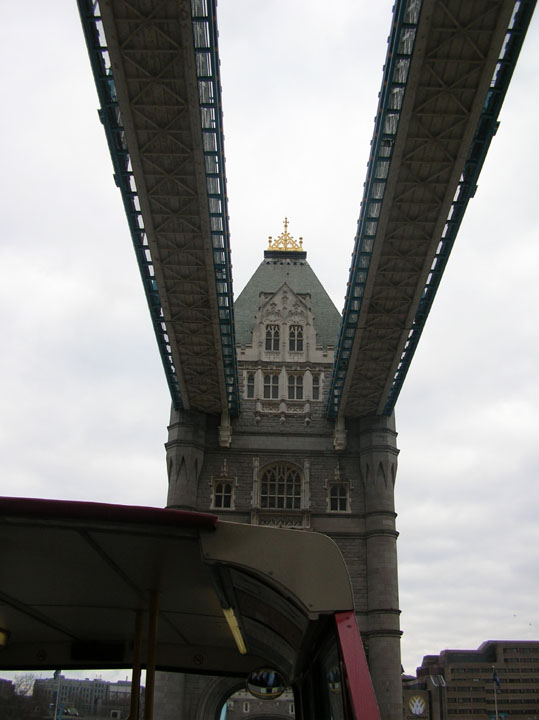
Crossing the Tower Bridge
Phase 1 of our visit to London - touring the city in an open-top bus - was just about over. Phase 2 was a few hours away: seeing Les Miserables at the Queen's Theater. In between we wanted to do some walking, some shopping, and some eating. But first we had a few more stops to make.

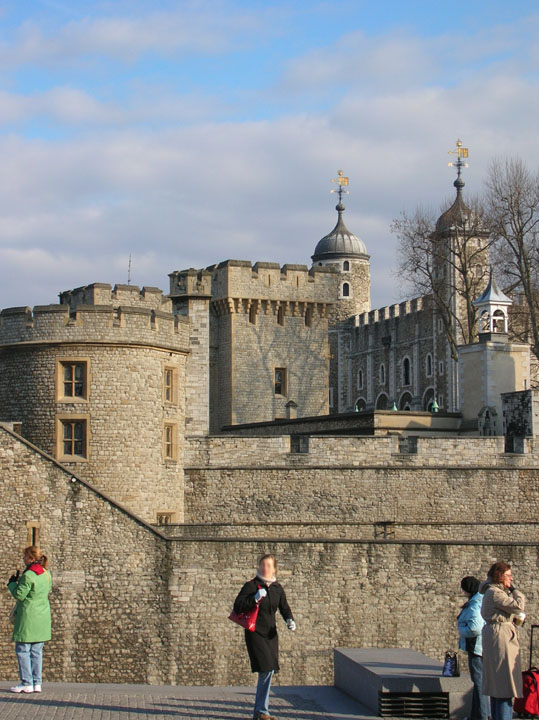
The Tower of London
The Tower of London is a nice place to visit, but you wouldn't want to be imprisoned, tortured, and executed there. It's smaller than you would think for a place with so much history. Once again we were faced with an unacceptably long line for the tour itself. Fortunately the gift shop was open and there was no line there. Seeing a costumed Beefeater added to the sense that I was in a sort of historical amusement park with its long lines and gift shops and costumed characters. (These guys aren't just random people dressed in costumes but are actual retired military personnel, so the perception that they are the British equivalent of Mickey Mouse at Disneyworld is probably moderately annoying.)

Wellington Arch
We boarded our bus with the intent of riding the tour around past our starting point at the Marble Arch and back to Piccadilly Circus, which is relatively close to the West End theaters. Along the way we crossed the Blackfriars Bridge, rode along the Victoria Embankment, passed the London Eye on the far bank of the Thames, saw Big Ben once again, flew past Westminster Abbey and Buckingham Palace, zipped through Victoria Station, careened past Wellington Arch, made it around Hyde Park Corner without hitting any female astrophysicists on mopeds, rounded the Marble Arch, and headed on to Piccadilly Circus. I took pictures along the way, including one of this tiny car:

Look! A tiny, tiny car.
(Soon to be marketed in the U.S. as the "Smart Car")

Eventually we made our way to Piccadilly Circus and left the bus tour. It is said that you cannot stand for more than 37 minutes at Piccadilly Circus without meeting someone you know. I was wary of testing this theory - you never know who might show up.

Piccadilly Circus at night
We did some shopping and found a restaurant - the Miso Noodle Bar on Haymarket. This was a great little place, with good food, generous portions, courteous staff, and reasonable prices. We shared our table with an older couple from about an hour outside of London who came into town a few times a year, and were there that day to see a play. They were wrapping things up for the day, and kindly gave us a compact map of the city to help us during our visit. To my everlasting regret, I failed to give them my card with the address of this blog.

Les Miserables at the Queen's Theater was great. Jean Valjean was played by Tim Godwin, the understudy for the role, but I can't imagine the regular performer doing a better job. (I must admit that I found his resemblance to a bearded Jack Black in the opening scenes a little distracting!) Cornell John dominated the production in the part of Javert - during his ovation, I think I saw his smile broaden a bit when the audience's applause and whistles were punctuated by a certain American whooping from the balcony. The peformance was done on a purpose-built rotating stage which was used to simulate travel, provide in-the round views of scenes to all audience members, or simply allow for quick scene changes. I'd be interested in seeing how other touring companies stage the production, so I'll have to try to catch the show if it ever comes through Wilkes-Barre or Scranton.

After the show, it was just a matter of getting a Night Bus back to our hotel, or to Paddington Station, or to anything close. I managed to get us on a bus going the wrong way. We got off near St. Paul's, which is a pretty desolate spot in the middle of the night, but were able to quickly reboard a bus going in the right direction.

We made it back to our hotel, drew up some plans for the next day's adventures, and passed out.

Friday, February 03, 2006

Welcome to the Two Minutes Hate

And tell the pleasant prince this mock of his
Hath turn'd his balls to gun-stones*; and his soul
Shall stand sore charged for the wasteful vengeance
That shall fly with them: for many a thousand widows
Shall this his mock mock out of their dear husbands;
Mock mothers from their sons, mock castles down;
And some are yet ungotten and unborn
That shall have cause to curse the Dauphin's scorn.

- Henry V, Act I, Scene 2
**


I am trying to write something about this whole cartoons-of-Mohammed situation, but the posturing that's going on makes me want to fling my keyboard aside.

Of course I support freedom of speech and freedom of expression. But suddenly legions of folks who just days ago would gladly have seen Hillary Clinton or Al Gore or John Kerry cast into the deepest recesses of Alberto Gonzales's basement torture chamber / rec room for remarks they have made blaspheming against the Unitary President and his Party of the Permanent Majority are now casting themselves as defenders of free expression and freedom of speech - specifically, the right, the duty, the moral obligation to publish cartoons depicting Mohammed.

I don't buy it. If you have even a passing knowledge of Islam, you probably know that their religion prohibits pictorial depictions of Mohammed. If you have even a little sensitivity, you would understand that Muslims of good faith could become incensed about such depictions. This isn't a free speech issue. This is an intentional provocation. This is an extended two minutes hate. And I won't take part in it.


* Good King Harry is talking about
tennis balls. Go get the 1989 Kenneth Branagh movie version. It kicks ass.

**I could have sworn that this passage contained the line "Mock eyes from heads", but I can't find it anywhere. Or is that something Branagh just kinda threw in?