Showing posts sorted by relevance for query czestachowa. Sort by date Show all posts

Tuesday, November 08, 2005

St. Mary's School

Our Lady of Czestachowa Church and School
(a.k.a. St. Mary's)
Nanticoke, PA
March 2005


I attended Catholic shool from Kindergarten through the Eighth Grade. Back then, in the mid-1970's to early-1980's, Our Lady of Czestachowa (my parish, commonly called St. Mary's) had a sort of school-sharing arrangement with another primarily Polish parish, St. Stanislaus. The plan was that all Kindergarteners from both parishes would go to Kindergarten at St. Mary's. First Grade would also be at St. Mary's, but second grade would be at St. Stan's. All even-numbered grades would be at St. Stan's, all odd-numbered grades would be at St. Mary's.

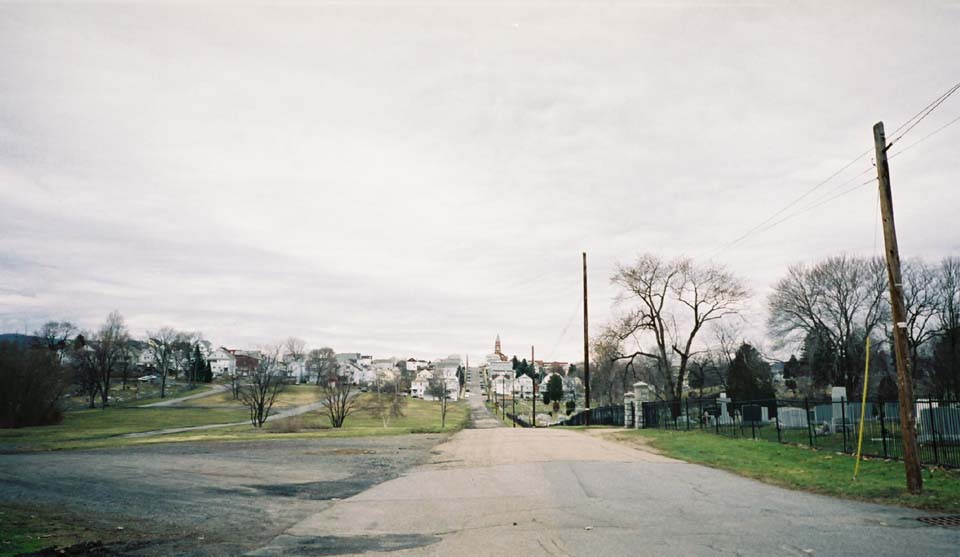
Our Lady of Czestachowah Church
March 2005


That was the plan, anyway. It had gone on like that some time before I started school, but it ended for me after Fourth Grade. From that point on, all classes would be consolidated at St. Mary's. Never mind that there weren't enough classrooms; classes would simply be combined. Fifth and Sixth Grade in one room, Seventh and Eighth Grade in another.

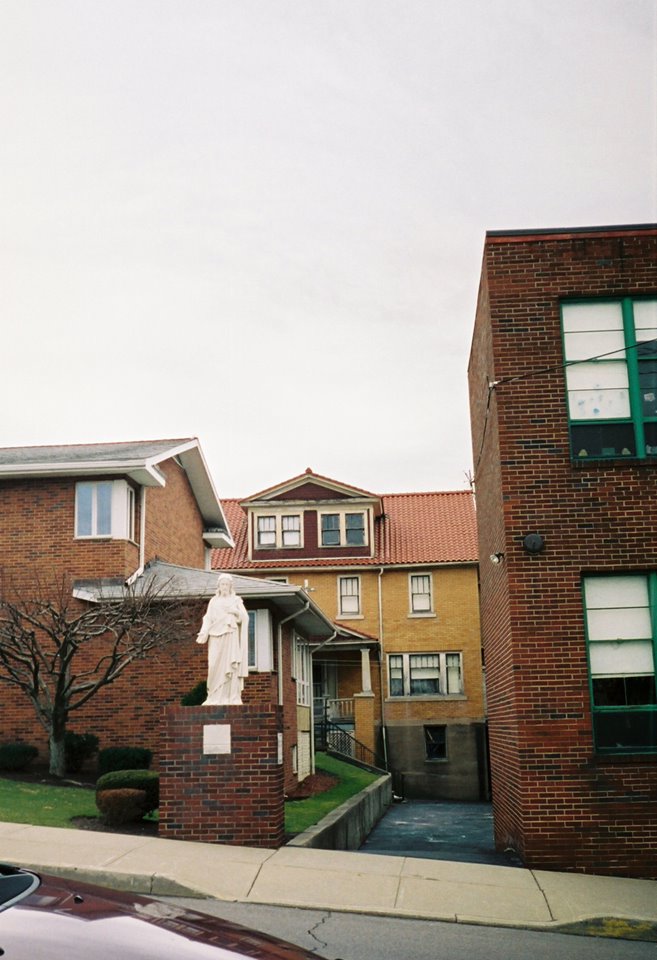
From left to right:
New Rectory (built in the 1980's)
Convent (disused for about 20 years, slated for demolition)
St. Mary's School
March 2005

Things got worse after I graduated from Eighth Grade in 1981. Soon St. Mary's and St. Stan's combined their schools with the much larger Holy Trinity school, which was located two blocks North of St. Mary's and two blocks West of St. Stan's. The "new" combined school, which was located in the "old" Holy Trinity School, was christened Pope John Paul II School, after the young, vigorous Polish Pope.

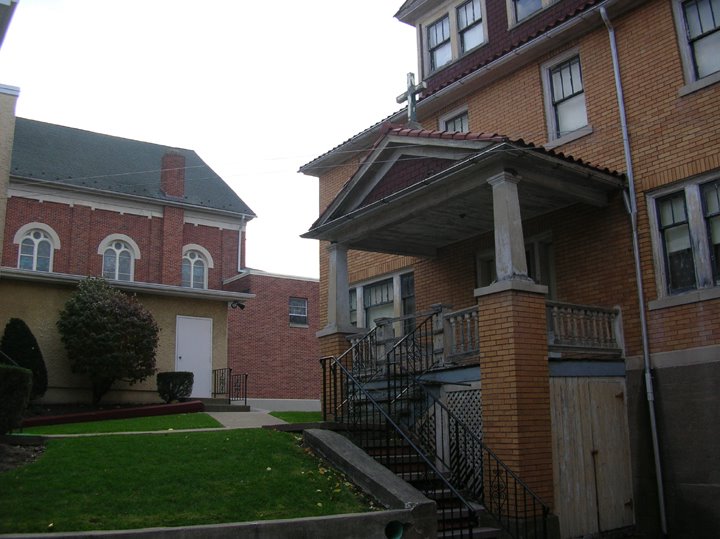
Wind Tunnel and Nuns' Bridge
(Any wind would get caught between the school and the convent and create a mini-tornado.
Catholic schoolgirls wore skirts, by the way.)
November 6th, 2005


I have fond memories of St. Mary's school. It had its educational shortcomings - at any moment Math, Arts, or Science class could be interrupted for a a supplemental Religion class. The Science textbooks were good, though, and no one stopped me from reading the "advanced" chapters in the back of the book, the stuff we never seemed to get to each year. The Math, English, and Reading classes were also top-notch, so I must give a nod there.

Convent
November 6th, 2005


I was an Altar Boy back in those days. About one week out of every month I would draw 7:00 daily Mass duty - up at 6:00, out of the house by 6:30, a quick morning Mass attended by between zero and ten parishoners, down to my grandmother's house for breakfast, then off to school for 8:30. Each week I would serve one Sunday Mass - 7:00, 9:00, 11:00, or even 7:15 Saturday evening. Once or twice a month I might get called to serve a Funeral - two hours out of school, hang out with a dead body, ride in a Cadillac, maybe get a dollar or two as a tip. The big money was to be made on Saturdays at Weddings, when you might get a tip of $5 or more.


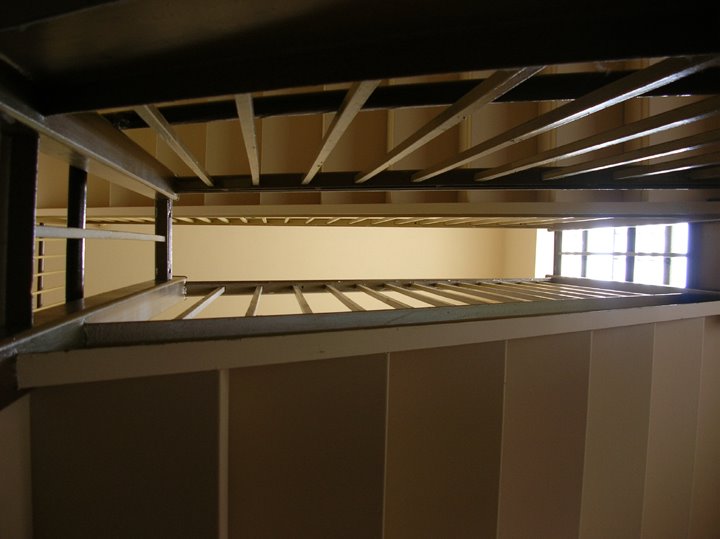
Rear Stairwell
November 6th, 2005


The school isn't entirely abandoned now. I think it still serves as a Head Start school for underprivileged kids. But it's lost a lot of the identity that it had when I was there. And yet it still stands.

But not for long, I fear. Like Three-O-Nina, I cannot imagine that this old relic of a bygone era will stand forever. Thousands, maybe tens of thousands of kids passed through its halls and learned about Jesus and Kangaroo Mice and negative numbers and The Red Badge of Courage there. Someday this school will only live on in their fading memories.

For what it's worth, I offer this bid to whatever immortality this medium has to offer.

Sunday, October 12, 2008

Angel, Dark Angel

My parish church is closing. Probably. Maybe. Churches throughout the Diocese of Scranton are closing, and St. Mary's in Nanticoke (a.k.a. Our Lady of Czestachowa) is shortlisted for closing. Though Bishop Martino has recently stated that nothing is final, nothing is decided yet. Maybe he's waiting for election results to come in to let him know which parishes voted according to his directive issued last week.

I'm operating on the assumption that St. Mary's will be closed, and that we will be consolidated along with two or three other parishes into a single church with no air conditioning, poor handicapped access, and ample parking for up to 30 vehicles. Word is that St. Mary's will be a backup or secondary church to be used for special occasions, like when more than one Nanticoke couple wants to get married in a Catholic Church on the same weekend. Still, I worry that it will fall into disrepair while it is idle, and some things will be lost forever due to neglect.

Among these are the stained glass windows. These are magnificent works of art, perhaps as old as the church itself, more than a century old. They bear the names of their donors, and some of these names are familiar to anyone who lives in Nanticoke. For example, one was donated by a "K.M. Smith." For decades I have assumed that this means it was donated by the children of the K.M. Smith Elementary school. But only last week it occurred to me that this was donated by the school's namesake. Now I want to find out who K.M. Smith was.

I've started photographing these windows. This is something I have thought about for a very long time. Ideally a project to capture these windows as photographic images would involve a large-format camera on a rig that allows it to image a small section of each window at a time, and create a mosaic of the window that will avoid having any distortion due to perspective issues. Less ideally the project would be undertaken by some guy with a Nikon Coolpix L4 who was waiting for his cousin's wedding to begin. But, hey, it's an imperfect world.

So before the wedding, and after Mass the next day, and after Mass today, I have been trying to capture each and every stained glass window in the church. The pictures are not perfect: they are sometimes blurred, rarely encompass everything I would like to grab, and always involve some perspective distortion. But they're better than nothing. I will not let this church, and these windows, pass beyond the veil unremembered.

I've got them all, I think. I'll go back and get them again and again, as often as I can, trying to achieve quality through quantity. But I've got them all. Here's one that's been a favorite of mine since I was a little kid.

This window is remarkable for several reasons. It may contain the only image of the adult Jesus in the main church windows. (I think there's another in the baptismal font area, but I think that's a later addition.) It's the only window that I could see that shows signs of wear, on both the images of St. Michael and Jesus. (A cleaning attempt gone awry?) It's the only one that shows an angel, as far as I know the only angel who is also classified as a saint. (Gabriel is a named angel, but I'm not sure he/she/it is considered a saint.) It's the only figure in the windows holding a weapon. (Others hold miniature churches, books, staves, crowns, but only Michael gets a sword.)

And...it sure as heck looks like a black guy.

Try to understand: Nanticoke was a coal mining town, settled primarily by Roman Catholic Poles, though several other nationalities and religions were represented. Until the middle of the last century the population was fairly static: your parents lived here, you lived here, and odds were your spouse was someone from in town. Very few people moved into town. So very few black people moved into town. Having a black guy in a century-old stained glass window in church is a pretty big thing. (Though I cannot say for sure if anyone else has ever remarked upon it.)

Brightness and contrast enhanced to show detail
Of course, one could argue that St. Michael was an angel, and as we all learned from the St. Joseph's Baltimore Catechism, "Angels are spirits that ain't got no bodies." (Well, that's how I remember learning it. From the older children.) So the artist had pretty free reign to depict St. Michael in whatever way he wanted. As a black guy with an Afro or whatever. And apparently, that's just what he did.

Damn, he looks pretty pleased with himself.

For all these years, a black guy has looked over the Polish parishioners of Our Lady of Czestachowa, sword in his hand, wings on his back, crown on his Afro, a crocodile-lizard-serpent version of Satan under his feet.

Note the distinctly Medieval footwear here. I only just noticed the flipped-up
portion of the hem of St. Michael's skirt. Is he preparing to pee on Satan?
No wonder the crocodile-lizard-serpent looks worried.

It's a little thing. Just a window, just a detail in a building slated for closing. But it's part of the story of this Parish, of the city of Nanticoke itself. And it's something that should not be lost. Somebody needs to remember it.


Title Reference: "Angel, Dark Angel", short story by Roger Zelazny.

Sunday, June 20, 2010

Holy Child to close June 27, 2010

On Sunday, June 27, 2010, phase 1 of the consolidation of Roman Catholic parishes in the City of Nanticoke, Pennsylvania will conclude with the closure of Holy Child church in Sheatown.

I don't have much history with Holy Child. I seem to recall being there once when I was young, maybe in first grade, maybe later; we were at the nearby St. Stanislaus nursing home to sing Christmas Carols for the old folks, and afterwards went to a Mass at the church. But I never went there again until, I think, sometime last year or the year before. I went there out of curiosity, and because the 9:00 Sunday service was sometimes a convenient alternative to the 8:00 service at St. Stan's on rotations when Saturday night was my last night of work, and I felt like dawdling at breakfast at Cracker Barrel or wherever.

The church is built in what I believe is a Dutch style, complementing the buildings of the old, long-vacant St. Stanislaus Orphanage that tower over it on either side. The church, I have heard, was originally a chapel for the children of the orphanage - some of them children whose parents had died, some of them children whose parents were very much alive but had decided that they were not interested in playing the roles of parents. Despite its small size and crowded location, it is a surprisingly bright and airy church - the brightness the result of the extensive use of clear glass in the stained glass windows, and the airiness brought about by ceiling fans and vent windows.


The main altar is located in a recessed area that creates a sense of separateness between the celebrants and the congregation. The altar itself, as well as the side altars, all appear to be carved from a single piece of pinkish stone with gray veining - soapstone, perhaps? The large wall-mounted depiction of the crucified Christ is surmounted by a Rose window (see below), and windows on the sides of the recess admit additional natural light.

The angels on the sides of the altar were of special interest to me. From my youth through the last major renovation in 1998, the area behind the main altar of St. Mary's church, my home parish, featured an image of Mary and Jesus (in their dark-skinned, cut-faced Czestachowa appearance) attended by two angels. I always had the impression that rather than being directly painted on the wall, these were actually appliques of some sort, like large, painted pieces of wallpaper cut into specific shapes. (This impression came from seeing various corners and edges curl up from time to time.) The angels exactly resembled the two angels seen here. I wonder if these are the appliques from St. Mary's, removed and repurposed after the renovation? Or could the two churches have received similar decorative items from the same supplier?


A close-up of the Rose window. The four central panes appear to be the symbols of the four Evangelists: clockwise from upper left, the Lion of Mark, Man of Matthew, Bull of Luke, and Eagle of John.


I don't know if I have seen pendants like this elsewhere. There are two of them, one in front of each of the two side altars. The letters are a Christogram. From Wikipedia:
In the Latin-speaking Christianity of medieval Western Europe (and so among Catholics and many Protestants today), the most common Christogram is "IHS" or "IHC", denoting the first three letters of the Greek name of Jesus, iota-eta-sigma, or ΙΗΣ. The Greek letter iota is represented by I, and the eta by H, while the Greek letter sigma is either in its lunate form, represented by C, or its final form, represented by S. Because the Latin-alphabet letters I and J were not systematically distinguished until the 17th century, "JHS" and "JHC" are equivalent to "IHS" and "IHC".

A votive light of a style I have never seen before.


As mentioned earlier, the stained glass windows in this church use lots of clear glass, admitting maximum light. The style of these windows is unique among the churches of Nanticoke; aside from a single similar depiction of a saint in both the St. Mary's and Holy Trinity windows, each of the churches of Nanticoke has a distinct set of windows in a style different from all the others.


The right side of the church as seen from the front. The hanging lights had ornately decorated glass, though much of the detail is washed out in this image. Note the large duct for the air conditioning system in the choir loft. Details like this give the church an almost industrial feel.


The left side of the church as seen from the front. Each of these windows bears a dedication inscription, and I'm sure the names present a history of the parish over its lifetime. I am also sure that the small, intricately carved Stations of the Cross have a story of their own, though as an outsider to this parish, I am unfamiliar with it.


The choir loft, dominated by a large stained glass window depicting the Nativity.


A close-up of the Nativity window. One of the choir members seen here commented to my mom that she hoped I got a picture of this window, which is apparently the only window in all of Nanticoke to depict the Nativity. You can judge how well I captured this in the image above. I hope that sometime before the doors are locked forever, someone with a better camera and a more in-depth knowledge of this parish photographically documents Holy Child church.


The rear entrance. The buildings of the orphanage, undergoing renovation as they are turned into apartments, seem to envelop the church - something that is not apparent from the front. But as of next week, this will no longer be a church.

I have attended Mass here three or four times over the past year or so. Most times the church, while small, was only partially full. Today as I arrived I was surprised to find no parking available near the church or even in the lot of the nursing home (no longer St. Stan's) that still operates on the other side of the lot. Inside I found a packed church, and needed an usher to locate a seat for me. If this penultimate Mass was any indication, next week's closing Mass will be very crowded - standing room only. Tragically, it seems that if this had been the case all the while, this church might not be on the list of churches being closed as part of the local parish consolidation.

Saturday, October 18, 2008

The Churches of Nanticoke, Part 1


This is a project I've been kicking around for several years, at least since this post. And thanks to a last-minute schedule change this morning, I was able to get the project started today.

Nanticoke has a lot of churches. How many, I'm still not sure - that depends on what your definition of "Nanticoke" is. Counting just the main body of the city itself, there are over twenty. And I have set out to photograph them all.

I think I got them, all in one day! But this is too much to mash together into a single post. So I've tried to break up the churches into semi-logical groupings, more or less by location.


I started my tour of Nanticoke's churches around 9:00 this morning with a trip to my own church, Our Lady of Czestachowa (also known as St. Mary's), located at 1030 South Hanover Street. I have written about this church before, and it is the initial focus of The Stained Glass Project, so I will be writing more about it in the future.


Heading North along Hanover Street, the first church we encounter is St. John's Slovak Lutheran Church. For some reason this church is not listed in the directory of churches on the Nanticoke City 2006 Community Guide & Map that I had hanging next to the 2008 Recycling Schedule.* It is possible that it was erroneously thought to be a duplicate entry for St. John's Lutheran Church, which is located several blocks away.


According to the sign in front, this church has been around for 120 years as of 2008. It is located at the intersection of Hanover and West Ridge Streets, on the other side of Ridge from Holy Trinity.


Holy Trinity, located at 520 Hanover Street, is a huge, impressive church with an incongruously small parking lot located on the other side of the busiest part of Hanover Street - a holdover from a time when churches were neighborhood affairs, and most parishioners walked to church each Sunday. It is imposing on the inside as well, with limited handicapped access and many stairs. The absence of a modern ventilation system results in a striking demonstration of what Purgatory might be like, particularly during long, hot Summer masses. This is the church currently slated to be the primary Catholic church in Nanticoke, post-consolidation.

Holy Trinity parking lot, across Hanover Street from the church.
Some people also park on Hanover Street itself.


St. Mary's parking lot, to same scale.
("Eye altitude" adjusted for difference in elevation.)


Sadly, St. Nicholas Ukranian Catholic Church, located several blocks further North at the corner of Hanover and Green Streets, is now closed, and has been for some time.

We now backtrack a bit for the last stop in the first part of our tour. St. Stanislaus is located at 38 East Church Street, just a few blocks East of Holy Trinity. For many years a special relationship existed between St. Mary's and St. Stan's, and for a while the two churches took responsibility for alternate grades of students - St. Mary's had Kindergarten, First Grade, and all the subsequent odd grades, while St. Stan's had the even-numbered grades. (Each retained its own basketball team, of course.)

This concludes the first leg of the tour of the Churches of Nanticoke. There are many more churches to cover, so I expect to spread this out over another two or three posts.


Map showing the location of the churches featured on this part of the tour. Note the location of this group on the larger map of Nanticoke.


*Also the schedules from 2007 and 2006, just in case those years ever come around again.

Monday, January 16, 2006

Theomeandering


I was raised in the same small town where I still live. Nanticoke is predominantly Polish, predominantly Roman Catholic. I went to Church every Sunday since before I could walk, and in my youth went to my grandmother's for a brunch of Polish sausage and white bread and coffee afterwards every week. I spent the first nine years of my education in Catholic school, and most of those years served as an altar boy.

The priest at our parish for most of those years was Father Piontek. He was a crass, gruff man, balding, easily annoyed, with liver spots and at least three chins and vertical creases on his earlobes that have been correlated to an increased likelihood of a heart attack, fond of cigars and Cadillacs and black cowboy hats. He slurred his way through most Masses in a loud, flat voice, the words having become blurred by repitition into little more than sounds emitted from the larynx without any conscious processing whatsoever.

The nuns at our school were part of a dying breed, and they knew it. Only a few wore the full old-fashioned Carmelite habit. Through the years more and more lay teachers took over classes, and in the end both the school and the convent closed.

Father Piontek was eventually transferred to another parish in town, and Father Krafchak came to replace him. By this time I was in High School, or very nearly so, and was stepping away from my role as an altar boy. I was becoming more distanced from the day-to-day activity of my parish, but this seemed only natural as I entered my teens.

After High School I moved on to the University of Scranton, a Jesuit university located in Scranton, Pennsylvania. While it was only a half-hour from my home, my full tuition scholarship made on-campus housing financially attainable. I took up residence there and became a part of the U of S community.

I was not active in Campus Ministries beyond my attendance at the weekly Mass. In my Freshman year I became involved with a group called Students Against Hunger - a group whose name changed, during the writing of a press release for the campus newspaper, into Students For Social Justice.

Students For Social Justice had connections to Campus Ministries. Our faculty advisor was one of the priests in the Campus Ministries office. We hung out in their offices and made friends with Pam Tigrett, the Campus Ministries secretary.

This was in the late 1980's. Oppressive and murderous right-wing regimes were in power in parts of Central and South America, operating with the blessing and support of the Reagan administration. In Nicaragua a leftist Communist-supported regime was in power, so in this case the Reagan administration was with a group known as the Contra rebels - described as "the moral equivalent of our Founding Fathers" by Ronald Reagan, described as rapists and murderers by people in the field. A movement known as Liberation Theology was taking root among those who worked with the poor and the oppressed in these countries, only to be smacked down and disavowed by a Pope who despised anything that had the taint of Communism, regardless of what the alternative might be.

Our Lady of Czestachowa Church and School
(a.k.a. St. Mary's)
Nanticoke, PA

It was during these years that I began to question both Church and State. The Reagan administration was blatantly wrong on a great many topics from a moral and ethical point of view. The Church, as I saw it, was wrong on the issue of Liberation Theology, just as it was wrong on the issue of contraception. But still I went to Mass every week.

Our Lady of Czestachowah Church

After graduating from Scranton I went on to a brief but horrible semester as a graduate student at the University of Delaware. It was there that I realized I would not be able to fulfill my dream of earning a Ph.D. in Physics by age 27 and settling into a career of writing advanced science books for the general public.

There was a Catholic chapel on the campus of the University of Delaware. In Delaware Catholics are fewer and farther between than in Northeastern Pennsylvania, so despite the campus being several times the size of the U of S, Delaware's chapel was perhaps somewhat smaller than the campus chapel in Scranton. That chapel became my church for the two years of my exile in Delaware.

From left to right:
New Rectory (built in the 1980's)
Convent (disused for about 20 years, slated for demolition)
St. Mary's School

Upon my return to Pennsylvania I almost immediately took on the role of full-time caregiver to my 81-year-old grandmother, who was floored with a severe case of sciatica. Both of my parents were working full-time, my brother was taking classes to become a nurse, and my sister was living out-of-state. For more than six months this was my job, to wait on her and administer her medications and cook her meals and help her get to the bathroom or into bed.

I returned to the parish of my childhood to find things subtly different. Time had had its way with the parish, and many of the old faces were gone forever. The nuns were gone, too, as was the old rectory.

My grandmother eventually recovered from her sciatica, only to be felled almost immediately by a stroke.

Wind Tunnel and Nuns' Bridge

Strokes are terrible things. Her recovery was slow and incomplete. She returned to stay with us for several more years, until her condition had deteriorated to the point that she needed full-time medical attention.

My grandmother bounced from one nursing home to another. None of them were right for her, but in the end she settled into one that was more right than all the other ones. This one had one great advantage over the others, for her at least: it was a Catholic institution, and provided a daily and weekly Mass for the residents.

For the next few years this became my parish as I attended Sunday Mass with my grandmother. The Mass provided a continuity for her with her past, a continuity connecting the Catholic upbringing of her childhood with the daily attendance of the Mass in her adult years to the suffering and loss of freedom of her final years. She enjoyed it. At the Sunday service I would pull out some token cash for the collection basket, a dollar for me and a dollar for her. Once in a while she would look at the profferred dollar and say, "Put in five for me."

She died, as we all eventually will. I saw her body in the hospital early that morning - it was a Sunday - and went to the nursing home as soon as the doors opened so I could talk to the head nurse. She told me about how my grandmother had been talking and joking with the nurses when they came to give her medication early in the morning. An hour later they found her unresponsive and without a pulse in her bed. They had tried, frantically, to bring her back while they waited for the ambulance to arrive. They cried, she told me. They had all loved her vey much.

I looked at the clock. It was almost time for church.

I went to the nursing home's chapel. The chapel was not designed to accommodate a large number of wheelchair-bound attendees. Most Sundays my grandmother and I stood in the hallway outside of the chapel along with a dozen or so other residents. We had our regular spot, and other people had their regular spots, and we were all in more or less the same relative positions each week.

That Sunday I stood alone in our regular spot. People who didn't know before that my grandmother had died, knew then.

Convent

The nursing home remained my parish for several years after my grandmother's death until Masses there were discontinued as part of the ongoing diocesean implosion. Every once in a while I would remember my grandmother's periodic request and I would put six dollars in the collection basket - one for me, five for her.

After Masses at the nursing home were discontinued I returned, grudgingly, to the parish of my youth. I felt very little connection with it anymore. But still I attended Mass every week.

It was during one of these Masses that I had the closest thing I have ever had to a genuine religious experience. It was just after the Pope - Pope John Paul II - had died in 2005, during the Liturgy of the Eucharist, the portion of the Mass in which the bread and wine are consecrated and, we are told, transubstantiate into the actual body and blood of Christ. Looking at the ceremony, seeing the lights glint off the golden chalice and candlesticks, hearing the familiar words, I was suddenly impressed with the feeling that this was the moment that united all Catholics together. I saw all of the Masses being held everywhere in the world at all times in the past, present, and future, stictched together by this golden thread. As I pulled out of the mental rabbit-hole that I was pluging into headfirst, I thought to myself: This is the ultimate Catholic water-cooler moment.

Parishes are closing all around us. Father Piontek is dead, my grandmother is dead, my father is dead, my uncle, who was our church organist for many years, is dead. Father Krafchak is retiring in a few months, and the future of our parish is uncertain. I still believe that the Catholic Church is dead wrong about many issues. I hold out hope that God will someday steer the apostolic hierarchy in the right direction.

And I still go to Mass every week.

Rear Stairwell
St. Mary's School

This started out as something very different from what it became. It was originally to be an essay on religion and the politics of the Liberal blogger. Instead it became a meander through my life as seen through the filter of religion and, especially, the Mass. It comes as a surprise to some of my conservative friends and acquaintainces when they discover that I attend Mass regularly. Such a thing does not fit in with their preconceived notion of what a "Liberal" is or does. But they need to learn that "Liberals" are not bound to act according to either the preconceived notions of "Conservatives" or the confabulations of "Conservative" pundits and demagogues.

There are those who claim positions of moral superiority and yet behave in manners that are morally reprehensible. I try to avoid making any such claims, or behaving in any such ways. My religion is not the religion of the Pharisee who makes a great show of his piety so that others will be impressed. My beliefs are more quietely expressed through my actions. Who I am, what I believe, is what I do. I can make no stronger statement of the role of my religious beliefs in my politics than that.

Sunday, January 29, 2012

Against the Dying of the Light

Here are the images from my Pecha Kucha presentation, "Against the Dying of the Light: Stained Glass Windows and the Passing of an Old World."  The text is what I plotted out ahead of time, but is not exactly what I said, though I tried to touch on the major points in the twenty seconds allowed for each slide.

I live in Nanticoke, about 25 miles southwest of Scranton. It's a small city that was once a coal mining town settled by immigrants, many (but not all) of them Polish. It's a city full of churches, many (but not all) of them Roman Catholic. (The church in the foreground is – was – St. Nicholas Ukrainian Catholic Church, and had been closed for several years when I took this picture in 2008.)

St. Francis Church was one of the older parishes with one of the newer structures. Unfortunately, a leaking roof resulted in structural damage which, according to independent estimates, could have been repaired for a fraction of the amount quoted by the Diocese of Scranton. But at the time the damage was discovered, parish consolidation plans were already in the works. And so the order came down from the bishop's office: the parish was to consolidate with nearby St. Joseph's, and the church would be closed and demolished.

The heartbreaking thought of a place that had been a religious, cultural, and social landmark for so many people in Nanticoke being condemned to demolition threw the coming diocese-wide parish consolidation plans into a stark light. How many more beloved places would be closed, shuttered, and eventually reduced to rubble?

My home parish is St. Mary's, formally known as Our Lady of Czestachowa. It's a small and humble church, set atop the highest point in the city. The structure has stood since the first years of the twentieth century, and generations have been baptized, married, and mourned within its walls. I served as an altar boy there from first grade through high school. From my earliest days I was fascinated with the stained glass windows of the church. If this building were to close, the sight of those windows would be gone forever. Could anyone do anything to preserve them?

I had thought about this for a while when one Saturday I found myself sitting in a pew in the church, waiting for my cousin to arrive for her wedding. I thought, what heck, why not? Why wait for someone else to professionally photograph these windows, when I can get started on it right now? And so I snapped this first image of the portraits of St. Francis of Sales and St. James with the mid-day October sun shining through the window.

I soon found more opportunities to gather photos, before Mass, after Mass, and once when the church was left open for people to come and offer prayers regarding the coming consolidation. When I arrived that day, camera and tripod in hand, I discovered that I had the church to myself. After saying a few prayers, I decided to do my praying with a camera, and set about the task of photographing the windows in the empty church, lit by the early-afternoon sun.

White sunlight strikes the windows from the outside and is filtered by the colored and painted glass, painting the interior of the church in the colors of the windows. These windows are over a century old and have stood the test of time, though paint has flaked off in places, grime has built up in others, and in at least one case a well-placed shot from a BB gun has resulted in a hole in one of the uppermost reaches of the windows, a hole that has been patched for decades.

The windows are pieces of history, and testaments to the history of the parish. Each one was financed and donated by a specific individual or group. All of the Ladies of the Rosary who collected funds to pay for their window are long since deceased; and even the children of St. Mary's who collected pennies and nickels and dimes to finance their window have grown old, died, and been buried for decades.

Each window is unique. Each piece of glass is different, an inhomogeneous blend of colors and opacities. These striations exist in three dimensions, not just two, so what you see depends entirely on the path that light takes from its source to the observer. Each window will look different depending on the time of day, the day of the year, the weather outside, the lighting inside, and the angle at which the viewer is looking at the window. 

And so the windows have become part of the churchgoing experience. Seeing the windows at sunrise is completely different from seeing them at sunset, and both are completely different from seeing them at night, when no light is coming from the outside and they are lit entirely by reflected light. Yet all those experiences, all that beauty, all the uniqueness yet to be experiences could be snuffed out with a decision from the diocese.

This is the first pair of portrait windows as you enter the church. The figures are each about five feet tall. At the bottom of each window are the donor plaques. (This pair was presented by the architects who designed the church.) Above that is a uniquely-colored panel that opens for ventilation. Above that, more decorations, then identifiers for the subjects in the windows, then the portrait windows themselves, then more vents (accessed by chains), a pair of decorative arches, and finally a small round window.

Looking more closely at the figures, we see St. Leo, formerly known as Pope Leo I, a fifth-century pope who holds a three-barred crosier actually dates from the Middle Ages - as does the plate armor worn by his neighbor, St. George, who was a figure from the third century. Most of what is “known” about St. George is legendary and likely apocryphal, including the story of his battle with a dragon – which apparently has escaped into St. Leo's portrait and is literally hiding behind his skirts.

Each pair of windows is topped with a round window, about ten inches across and about twenty feet off the ground, featuring an image and in most cases some text. The size and placement of these windows makes them nearly impossible to see clearly without visual aid from anywhere but the choir loft. The images do not seem to have a consistent theme, nor, for the most part, do they appear to be related to the portraits below. Some of these images have fared badly over the years, with some of the lettering flaking off and becoming unreadable.

Windows as old as the church, windows that have cast their light down on generations of parishioners. Ancient names preserved for posterity. Unique and ever-changing plays of light. Works of art perhaps beyond the skills of modern craftsmen. All this could be lost with a single decree. There are many things in this world that we take for granted that are passing away forever. If we have the power to preserve these things for future generations, do we not also have an obligation? Anyone with a camera can do the same thing I did. Anyone with a blog can share their images with the world.

When I first began posting my stained glass images to my blog, Another Monkey, a tattoo artist friend suggested that I should consider commemorating these windows with a tattoo. If I were to get one, it might be this one, of a smug-looking St. Michael the Archangel with the Devil under his feet. But then I thought about it: this window has been around for over a century. Any tattoo I might get would last another forty or fifty years. How transient a tribute to something that has been around for so long!


St. Mary's was not the only church in Nanticoke facing consolidation and closure. St. Stanislaus was one of the oldest churches in Nanticoke, and the first of three Parishes that were ethnically Polish. In the 1990's it underwent major renovations and became a bright, airy place, with modern stained-glass windows that admitted copious amounts of light. This photograph was taken on June 6, 2010, after the final Mass held there.  St. Stanislaus is now closed.

Holy Family Church was once the chapel for the St. Stanislaus Orphanage. It was a small but remarkably comfortable and airy place, with this rose window featuring images of the four Evangelists casting its light from behind the altar. This image was taken after the final Mass there, on June 20, 2010. Holy Family is now closed.

Holy Trinity was formed in the late 19th century by parishioners who broke away from St. Stanislaus. It is an enormous, opulent, ornate church. This stunning window is set above the main entrance to the church and faces East, and glows so much thatthe glass might be heavily doped with uranium. Holy Trinity no longer exists as a parish, but the building lives on as the primary worship site for Nanticoke Catholics, rechristened St. Faustina Kowalska parish.

We may be helpless to stop the passing of the old world, but we can at least create a record of its existence to share with future generations – if only to say “This is what you missed. We had it and we let it go away. Sorry about that.” But the time to do that is now, before these places are closed, and demolished, and turned to piles of rubble. 

And what of St. Mary's? What of the church that I grew up in, where I served as an altar boy? What of the windows that have looked down on generations of parishioners like glowing illustrations from a book?

St. Mary's no longer exists as a parish, but the building lives on as the Alternate Worship Site for the Parish of St. Faustina Kowalska. Its continued existence is not assured; very soon the diocese will assess whether a secondary site is necessary at all, and depending on that assessment, the building itself may be closed for good, and the sight of these stained glass windows may be forever denied to future generations – as has happened at the parishes of St. Francis, St. Stanislaus, St. Joseph, and Holy Family. For now, if you wish, you could still see these windows with your own eyes. In the future, perhaps all that will be left will be photographs and memories.